Tough Customers

 Bikes, E-commerce  Comments Off on Tough Customers
Jan 102012
 

By now you may have seen Matilda, a heretofore entirely unknown species of viper just found in East Africa. Word is Matilda is going to shoot right up the charts to a top “ultra-mega endangered” species status. In fact, I believe she’s being officially classified the second most rare and exotic yellow and black thing in the world.

So THAT'S what Stryper was thinking. All makes sense now.

Rare as Matilda may be, though, she’s nowhere near as unique as the people you encounter on the interwebs. You read so much these days about search engine optimization (SEO), search engine marketing (SEM), and all the various tactics and strategies for being found on the Internet, but rarely (if ever) do we find any advice for what to do if you are found. If there’s one thing brick-and-mortar guys most frequently find themselves unprepared for when venturing out into cyberspace, it’s the people.

Step one tends to always be admitting you have a problem, and that’s a good place to begin here as well. Even if you’ve been successfully selling products locally for thirty years, and think you’ve seen it all, until you sell products to people thousands of miles away, trust me, you haven’t even scratched the surface of “unique.” I know this to be fact, because even the most bizarre customer walking into your store is still a human being standing in front of another human being, but the “cloak of anonymity” afforded by sending an e-mail or making a phone call multiplies the confidence of even the most clear-headed and timid of customers, plus adds the barrier of distance to the challenge of clear communication. I have quite literally had employees hiding under desks in “anticipation” of the arrival of a long-term “challenging” customer, only to find that, once physically standing there with us in the store, this customer was an entirely different person–downright easy to get along with. In all my years in retail, I’ve only found one example of the opposite, a case in which the person was more challenging and unpleasant in person than he was on the phone and in e-mails, and even that was an extremely tough one to call. In the end, I give the slight edge in difficulty to his actual in-store presence only because he was a close talker who liked to chew tobacco and spit it in styrofoam cups.

No, remote is almost always far more challenging. When you take someone who’s a little off to begin with, and magnify that by the power of distance and anonymity, you have a serious customer service challenge, and one any retailer venturing on-line should be prepared to tackle.

Here’s an easy one–not even questions, but just responses. Consider these reactions to a simple news article posted about Matilda:

Most of those responses are about what you’d expect, right? But what about that first one? That one’s just a little bit different, isn’t it? Here’s a quick exercise any retailer considering a move on-line can do at home: imagine responses to posts. Not just question posts, but any posts. Literally write them down if that’s how you or your prospective customer service representatives think, but formulate responses to strange shit people write on the Internet. You already have responses down for face-to-face interactions related to your business; what you need to work on is weird. Get used to imagining what you might type or say if you were forced to respond to these things. This helps you to see things from the perspective of the people–sometimes quite unique people–willing to interact with you on the Internet.

Back to the first response up there. OK, so we have a guy whose avatar is wearing big shades and has flames as his background, and he’s not just telling you this snake is a gift from God, he wants you to know it’s “a gift of new year 2012 form god to us,” and that he wants “to give him a another name.” If we had to address this individual as a customer, and formulate a response to his post, we obviously have to recognize that–unlike the other people just posting, “Wow!” and “Pretty snake!”–this particular individual needs a little dose of validation. This might seem a little daunting at first, because you’re picking up that he might have strong feelings about something, but it’s not entirely clear what. Maybe he’s very religious, but just not religious enough to capitalize “god.” Maybe he’s being ironic, fucking with us here. Maybe (and this is probably the most extreme case), he’s actually dead serious and completely sincere and he really wants you to know that he thinks this snake is a gift God gave us as a sort of reward for surviving 2011. We don’t know his intentions, exactly, but we can read his words, and he’s clearly looking, as nearly everyone is, for a little thumbs up here. As with most slightly unique Internet characters out there, he actually makes a customer service person’s job easy: he tells you want you’re supposed to write back: we should all call this the “GIFT HORNED VIPER.” Even though this doesn’t necessarily make any sense (why is this spooky-ass dangerous thing a “Gift” while we have to call a dog “Canis Familiaris”? and wouldn’t we have to name every species of every plant and animal “gift”-something?), the safe bet here is of course to smile and nod. So easy enough to agree, but we’re supposed to be customer service and educating the customer a bit, right? Not really good enough to just type, “Fuckin’ A!” and hit “send.” And yet, our judgment tells us this is not an individual who’ll take constructive criticism well (maybe it’s the flames). We should commiserate, but also educate.

What about:

Seems like they always name a new species after the person who discovered it, or about something that person chooses. I’m not sure why they almost always do that. It’d be interesting if they considered different ways of naming.

If forced–like at gunpoint–to reply to that guy’s post, that’s what I’d type. Selling products on the Internet means being forced to reply to posts like that. It’s a crazy exercise, to be sure, but one that’s pretty good at prepping you for wading into the unknown. You don’t get to choose your customers. If you’re a small business getting ready to get on-line, develop your own familiarity with the personas people use when interacting on-line, be ready for curveballs, and practice up before you jump in. Those first few tentative customers that you find on the Internet should be treated like royalty, not only because they’re supporting your business, but because you can learn so much from them.

While there’s never really anything that can prepare you for interaction with every single scenario, here are a few quick tips for any business considering a transition from a strictly local presence, to the much broader community.

  1. Get Humility
    Whatever sales staff you intend to have interacting remotely with consumers absolutely need training. This doesn’t mean shipping them off to Mrs. Manners, but instead teaching them simple behaviors that help diffuse situations. (This is something we’ll come back to later.) The short version? It isn’t accurate to say the customer is always right, but it is true and necessary that the customer always comes first, and that means before personal issues, hangovers, bad days, exhaustion, and whatever else your representatives may need to wade through. Every exchange is a story, and that story needs to be about the customer–even if you’re imparting wisdom (which pretty much defines good customer service), that wisdom must be solely based on the needs of the customer.
  2. Know Something
    If your representative doesn’t know more than the customer he’s there to help, you have a serious problem. Kindness and a willingness to help will only get you so far. You have to have the goods. It’s also far better to ensure a customer he or she will receive prompt follow-up after you consult a colleague more knowledgeable about that particular product than to try to muddle through. Often, when confronted with a stump the band question on the phone, the best service for the customer involves getting contact information, hanging up, immediately gathering the information, and getting back in touch. Customer don’t expect you to know everything, but they do expect you to know everything necessary to help them. Actual information within the hour beats immediate bullshit any day.
  3. Get Close
    These days, Skype and Google+ Hangouts can do a lot to bring a remote customer into your store. Consider creating a space for employees to really use these capabilities to build a stronger sense of connection with the customers. Nothing beats being in the store, but video chatting is as close at you can get.
  4. Empathize
    So simple sounding, but so nearly impossible to do sometimes. Any representative needs to be able–and willing–to put him or herself into the customer’s shoes. Often–particularly when dealing with the technical nature of mountain bike disc brakes, or road bike geometry–the customer may not even know how to formulate the question he needs to ask. It’s too easy to say this is the customer’s responsibility and leave it at that: it’s not. As customer service, it’s your obligation to work with the customer to figure out what it is he’s trying to articulate and work toward an answer. Rephrase the question. Offer examples of answers that might clarify. Do whatever it takes, but get in that person’s head and help. You will not believe the kind of loyalty this breeds in grateful customers, and, equally important, how good it makes a representative feel to actually help in this way.

It’s both semi-useful and entertaining as hell to focus in on understanding the mind of the on-line consumer–and the consumer in general–so I’d like to devote some time to this, and provide some more specific examples over the next few days. As always, email or comment suggestions for specific customer service scenarios we should look at here, and fresh topics. In keeping with the recent “You’re Better than Amazon” theme, I’m thinking about the customer service assets found in most bike shops, and how those can translate to a web presence, so that’s specifically where I’m going next.

Jan 092012
 

Come get some.

It’s almost time for me to start taking down my Christmas decorations, and that always puts me in the mind of massive historical logistics efforts, like marching war elephants over the Alps to attack Rome, or building a web site.

Interesting historical note: there is no such thing as an actual “war elephant.” Hannibal, the famous general who used elephants to attack Rome, took regular peaceful elephants and made them memorize Bob Parson’s® 16 Rules for Success in Business and Life in General to produce bloodthirsty killing machines. (Rule #4, about visualizing the worst possible scenario, was edited slightly, given that there was a very good chance you were going to be eaten.)

Anyway, I’m pretty sure I was rambling on about e-commerce last week, and how the little guys can compete against the likes of Amazon. This leads us almost directly to a look at how e-commerce sites–particularly those in the bike business–merchandise their products.

However you look at it, digital merchandising sucks. Everything that gets summed up instantly when a customer walks into your store, now has to be analyzed, categorized, broken into attributes that can be compared to similar products, formatted, and displayed. OK, maybe it’s not as hard as I’m making it sound there, except that it is. When it’s done really well, shoppers get the information they need without having to live chat or call or email–or go to another site. But doing it well is more challenging for some businesses than others. If you’re a small retailer, it’s important not to scale yourself into oblivion when it comes to assortment, or your product information is likely to bury you. Better still, only sell a few items and sell them to a clientele that doesn’t give a shit about anything but a product’s color. Consider opening yet another store catering to hipsters.

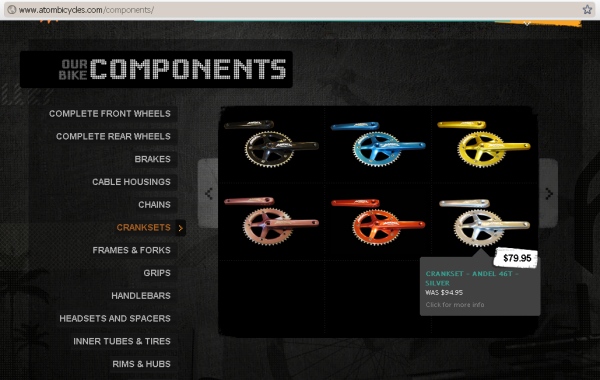
I found the source of the screen capture above, Atom Bicycles, doing what I sometimes do to torture myself: looking at what Smashing Magazine thinks are the best retail site designs. The cool thing about this is that most “user experience experts” don’t actually know what it means to truly participate in anything, beyond maybe collecting shoes (male) and “productivity enhancing apps” (female). Going to a “sexy geek” for recommendations about site navigation isn’t such a bad idea, but trusting said geek to also know whether a site’s navigation and product pages “work” or not is another story entirely. Smashing does what a lot of designer-centric site “reviews” do, which is punt on content and actual human usability by focusing exclusively on sites that don’t ask a lot from their shoppers (or people writing articles about web sites). This means the list of “35 Beautiful E-commerce Sites” they offered last year consists almost entirely of fashion designer direct sales sites, hipster boutique t-shirt stores, fancy wine sellers, and purveyors of expensive hand-madey looking crap (usually for kids, because polite kids in affluent but green families tend to stay mum, even when given a gift that “sucks wet ass”). No, seriously. That’s all they cover in this article. I think there are like seven t-shirt places alone.

I particularly like the text blurbs they offer about why each site is great. You can read them all, but here are my favorites, in no particular order:

  • “The website combines jQuery and Flash, which slows the loading speed, but given its objective, this is not critical.”

    One wonders what the objective is if it’s not pleasing customers with a site that functions well, but I guess some customers like the kind of good, saucy teasing that only a shittily loading page can offer. This likely explains the popular of mistressursulatellsyoutositandstay.org’s otherwise infuriating “under construction” home page.

  • “The products are not tagged or grouped into categories, but this is hardly an oversight given the store’s small size.”

    The fact that the seat belts don’t work is inconsequential, because the car doesn’t run anyway.

  • “Cellarthief is a beautiful online wine store that sells only three wines at a time. The Apple.com-inspired content blocks against the real-looking wood background shows how the classic spirit of the wine industry is fused with modern design values.”

    By “classic spirit,” I assume they mean “wealthy enough to start a web site without requiring profitability.

  • [blank]

    Yes, about one site, Hokey Croquis, they actually didn’t even bother to write anything, which turned out to be OK, because the retailer seemed to have gone out of business and the site removed anyway. To be fair, the “Not Found” page was clear and concise and had clean but interesting typography.

You get the idea. In fact, no fewer than four of the random sites I tried to click through to check out were now gone. Domain name sold. Out of business. Maybe they were too beautiful to live. Most telling, the word “information” appears nine times on this article’s page–once in the article itself, seven times in the comments people left, and once in the instructions on how to leave a comment. That pretty much tells us everything we need to know.

See, a good e-commerce site is based on solid information–there’s something substantial at its core. It’s that availability of information that led to suggest more brick-and-mortar shops consider getting themselves online and into the game, because they do have something to offer that many other sites don’t: substance.

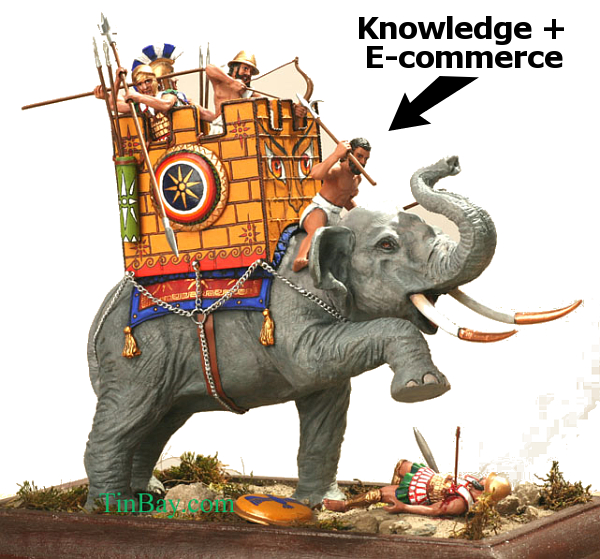
They have a story to tell, and they have product knowledge. That’s the war elephant in the room: knowledge. It’s what separates a good e-commerce site from a bad one.

War Chihuahuas can appear to be enormous, slick, impossible to compete against, until you see them to scale, held up against the enormous knowledge and authenticity of a genuine store, a quality bike shop. You can dress up a site that lacks those qualities, but something’s always missing. Small retailers might not have the fanciest outfits and shiniest weapons, but that story they have to tell, that authentic core–the heft–can make a big difference.

Are You Specialized?

 Bikes, Swine  Comments Off on Are You Specialized?
Jan 062012
 

Friday, and it seems Specialized has taken a break from dastardly deeds long enough for the world of bicycles and commerce to briefly focus on other things. I, for one, am moving quickly, before they drive a bus of puppies into a lake. So this post isn’t just about Specialized; it’s about actually being specialized.

The point my last few rants have been building up to is this: little guys can compete. Even against corporate giants within the same market. Amazon included. More specifically, brick and mortar bike shops can compete against online retailers. Online.

The elephant in the room for me as I was reading that letter from Mike Sinyard was just how repressed these dealers really were. The impression was that the Internet is this giant shadow that’s slowly passing over all of them, and all they can do is hoot and throw sticks at the darkness. Usually, it’s so fundamentally depressing to see this reaction that I’m hard-pressed to even address it, but this fear of change has been rampant in the bike industry for years now, and I think it’s time independent dealers started using the opposable thumb Darwin gave them and using tools. Instead of taking the isolationist approach that Sinyard advocates in his letter, why don’t more dealers sell products online?

Here’s why this isn’t such a crazy idea.

I’m not talking about dropping a 20,000 item catalog on your site and trying to go head to head with major e-commerce retailers. I’m talking about small steps to drive top line growth and sure up your reputation as a great bike shop. The technology and capability has never been easier to put an e-commerce application in place, and, if you can manage to use Quickbooks, you can safely and securely sell products to people all around the world. Furthermore, you–yes you, little bike shop–can compete against Amazon. Why? Because–if you’re a quality shop–you have one thing they don’t. You’re a real bike shop.

For that exact reason, the Internet needs you as much as you need it.

Here are some steps you can take to make it happen.

Understand It’s All About Communication

All the Internet gives you is a megaphone. If you’re fond of yelling stupid and offensive things–or more often just boring ones–you should find a voice for your business before taking it online. What is your real mission as a business? What do you stand for? In short, what’s your story?

When I started my tiny brick and mortar and e-commerce bike shop from a 1,000 square foot building, I never intended to compete with Amazon. My goal was to connect with a subset of dedicated cyclists based on a mutual love of bikes. The plan succeeded because the objective was first and foremost to communicate. Over the years, I’ve met many conventional brick-and-mortar bike retailers interested in becoming more active in e-commerce, and the most frequent misconception I hear from them involves communication: they incorrectly believe selling online is about things outside their comfort zone–pricing and assortment. Successfully selling online involves those things, in the same way brick-and-mortar selling does, but that isn’t the sum total of the experience for consumers. Communication is. Brands like Amazon incorrectly skew this perspective for small retailers. You’re not going to be Amazon, but you can be a more successful version of you, and that starts, not with asking yourself what products you’d sell and how to price them, but what you stand for. Details, like returns policy and email response turnaround time, work themselves out based on your overall plan for customer service, and the vision you have for taking care of your customers. The same qualities that make a great bike shop valuable to a walk-in customer, make that shop valuable to a site visitor online.

Know Your Strength

You can compete against Amazon because you’re authentic. You’re also an authority. Jeff Bezos doesn’t tell me which hydraulic disc brakes he likes best, and I wouldn’t care if he did, but if you grew up riding bicycles, and tried a bunch of things, and know what it’s like to have a rear brake fail fifteen downhill miles from home, I’m all ears. You, sir, are authentic.

Or at least you should be. Unfortunately, there are bike shops that have nothing to say. Their owners could just as easily be selling microwave ovens or dog food. These shops–regardless of how successful a ground game they may have, don’t transition as well to the digital world. Why? Because they primarily define themselves based on price, not service, and you’re not going to compete on price. Nor are you going to be able to keep up with the service demands of selling online, unless you believe in what you do, and are passionate about doing it well. Good shops are good shops, regardless of channel. Knowing that not everyone makes the cut is all the more motivation for quality shops to take their services to more people.

Focus on Your Core

You attack Amazon by knowing more about your products than they do. You know who has a strong defense against Amazon? Competitive Cyclist. Why? Because they’ve created value for the consumer that is tied directly to their brand, not just the products they sell. The key is content. Amazon, for all their size, absolutely cannot compete with a retailer who feels passionate about the product he or she is offering, and demonstrates in-depth knowledge. Avoid Amazon’s “one-stop shop” and “be everything to everyone” general philosophy and focus on what you know. This does two really great things: starting off, it minimizes the product information you have to manage, and it also lets your create more compelling content about fewer items, instead of phoning it on on many. For the brick and mortar retailer looking to explore e-commerce, focusing on a small subset of your most core products makes you capable of truly presenting those products–including accurate specs, high-quality information, videos and images, all curated by people who know what matters. That, not sticking your head in the sand and conceding e-commerce forever, fights Amazon.

This method is also particularly effective against Amazon because, like all large companies, they’re slow to react. If your shop employs a DH racer, and that’s what the culture of your shop is generally all about, you should be on the cutting edge of DH equipment. By the time Amazon realizes a new product exists, you could have sold three, or thirty, or three-hundred. At better margins than Amazon will ever see. Knowledge really is power.

Give the People Something for Nothing

This concept is the most difficult and is beyond just counter-intuitive to brick-and-mortar retailers: it’s toxic. But consumers are used to getting apps for free, using their G-mail accounts, and sharing information with their friends for free. What should your specific value proposition be for your site visitors? That’s up to you. It need be no more complicated than a weekly review of a product, or a helpful tip about maintenance, riding, or nutrition. Again, focus on what you already know, so that this is less of a chore and more like writing a note to a friend. Though it’s less obvious, brick-and-mortar bike shops are doing this constantly for customers on their showroom floors. Translating it to digital content is a new and unique challenge, but one that’s well worth it if you’d like to succeed.

More bike shops should be selling their products and their expertise online. In painting Amazon as the boogieman, gobbling up IBD sales, Specialized paints a pretty bleak picture of a future huddled around–and even more dependent upon–only a small assortment of products, but this is far from the only option.

The Internet continues to be defined by expansion, not regression. If you want to catch it, you jump where it’s going, not where it’s already been. Look at Etsy and Kickstarter and Facebook, and the common theme is specialization, the ability to communicate with and market to a core group of like-minded individuals who share your interests. So are you “specialized”? If so, you have a place on the Internet. You can choose to ignore that place, hide from it, or even rage against it, or you can find connections within the enormous pool of potential customers who would truly appreciate your shop’s love of bikes, humor, and dedication to service. Both Specialized and Amazon want to come between you and those customers, but companies still profiting from limiting peoples’ choices and building barriers to direct communication are not going to fare well in an economy that increasingly values the free and open exchange of goods and ideas between people. Open communication with your customers is the side to be on in this battle.

Jan 052012
 

Today was supposed to be all about e-commerce, but seems I picked a good week to criticize Specialized. By now, most of you have probably heard that they’ve chosen to sue Volagi, a new company that offers just one bike model, a disc brake road bike focused on big miles in less than ideal conditions. If you haven’t you can catch up with the basic announcement on Bicycle Retailer and Industry News, an interview with Robert Choi, founder of Volagi, on BikeRumor and a hell of a lot of praise for Volagi and venom for Specialized on Facebook.

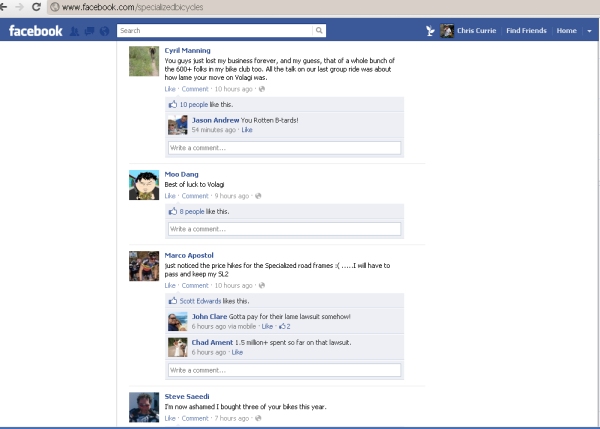
So far, maybe at the peril of Volagi’s own legal defense, all the news of this has been coming from Volagi founders, Robert Choi and Barley Forsman, while Specialized remains silent, so it’s impossible to know if the big red S really was wronged by Volagi in any way, but one look at the Specialized Facebook page this morning tells us they’ve definitely wronged themselves. Yes, two things have become pretty clear from reading the information Volagi’s put out:

  1. Forsman and Choi, who used to work at Specialized but claim convincingly to have had absolutely no connection to performance bike designs or information and to have begun work on their own bike design only after they’d left the company, are either doing a pretty flamboyant job of lying to everyone, or Specialized has finally played the legal card one too many times to stifle competition.
  2. Regardless of the outcome, somebody in Marketing or PR at Specialized probably should’ve talked with someone in legal before letting this shitbomb go off, because the blowback of attacking a small and nearly defenseless company–and one that may turn out to be completely innocent–is currently not working out very well for Specialized.

Specialized Facebook Page Capture 1/5/2012

Specialized’s own Facebook page suggests this lawsuit might not have been such a good move (word is they’re deleting negative posts, but, to their credit, I’ve not seen proof of that yet), but at least all this bully bullshit goes to illustrate a point today’s post was supposed to cover anyway. I’d planned to write today about how smaller companies can do battle with giants like Amazon, but Specialized has volunteered a glaring example of my first point.

Big Companies Suck at Social Media

Here are five things big companies need to do to fix their social media programs:

  1. Stop Pretending to Be People
    I’m not sure why U.S. Senators and the corporations themselves keep getting so confused about this, but corporations are at their worst when trying to act like people. They tend to do much better when they acknowledge that they include people, and then letting those people communicate with customers–not as pieces of the corporation, but as themselves. Sure, it might not be such a good time to let Bob in Accounting talk about his collection of Nazi memorabilia in a video blog post, but usually there are people within your company who are involved in interesting things. The Specialized Win Counter, that keeps track of race victories, and stuff like the Trail Crew and news about their advocacy and charitable work are nice, but all of those things could belong to any company, which leads us to our second reason.
  2. Let Us In
    Yes, I know your Chinese-made carbon fiber has a special strand orientation that’s top secret and blah, blah, but seriously, we all know interesting shit goes on inside companies, and we’re clearly willing to watch even the most asinine of things related to businesses and what businesses do. The companies making the best use of social media are using it to tear down barriers between themselves and their customers. If you’re not willing to do that, it shows.
  3. Stop Hiding Behind Mirrors
    The “hang a mirror and hope for the best” strategy is used by many companies–you know, let us post pictures on your wall and that should keep us busy so you can get back to running your company. But so what. It’s nice to help establish and support a community of people who use your product, but a bunch of blurry pictures of Stumpjumpers isn’t doing much for anyone. I think people would be much more interested in seeing your bikes, trick advanced release shit we’re not supposed to know about taped over and all. Santa Cruz consistently gets this right. It’s fine to pretend it’s all about the customer, but we can tell when you’re just hiding behind that.
  4. Talk About What Really Matters
    This most recent lawsuit Specialized is pushing exemplifies everything that’s wrong with social media in the hands of big companies, and why it’s so important to small companies. The reason Volagi jumped out early with information about the lawsuit is that it’s all the owners could think about. You sued them, Specialized. You attacked everything they’d worked for, and that’s forced their lives to revolve around this situation, and they can’t help but share the experience–not because doing so is a good “business tactic,” but because it’s genuinely all they can think about right now. Hearing the founders tell that story is profoundly compelling in ways I don’t think Specialized could understand. If Specialized really was this pissed off to have been “wronged” by a company, why is it that a lawsuit is the first we hear of it? Why not an “Imitation Isn’t the Sincerest Form of Flattery” corporate stance, including video features of how Specialized does things differently, and why their designs have been copied? Maybe that exists, but in general, I never see honest content like this from larger companies with dedicated PR and social media staff. Only companies that let the stakeholders speak out are compelling to follow. In social media circles, this lawsuit by Specialized is playing out so horribly partially because it came out of nowhere–we don’t think of Mike Sinyard or anyone else at Specialized as having any design skills or intellectual property to guard, because they never talk to us about those things. When the first we hear about it as a lawsuit against a little company, their anger seems bloodless, disingenuous, making their attack just another sleazy and anti-competitive act of big attacking small. If there’s true passion and defense of intellectual property behind this action, why haven’t we heard about it from the company before? The fact that most carbon road frames look eerily similar and uninspired anyway doesn’t support Specialized’s contention that something was stolen from them. I always follow a simple rule: if the owner of the company can’t tell us why his stuff is better, it’s probably not.
  5. Don’t be Assholes
    No, seriously. If what you do for a living is prey off others and add nothing of quality to the world, you probably don’t want people following you anyway. I honestly think Specialized has done some really great things, but that only makes the events of this week all the more senseless. There should be a Specialized story to tell that’s bigger than the lawsuit attack on Volagi. The fact that there isn’t is what’s really causing the problem here. Volagi is currently winning the hearts and minds of consumers (even owners of Specialized bikes) right now partially because we all know they have a story to tell–they’ve created the first viable disc brake equipped road bike and potentially defined an entirely new category of bikes. In the eyes of the public, Specialized, a company with no story to tell, is attacking Volagi, a company that was in the middle of telling us all a pretty compelling one. In social media terms, butting in without having anything to say is the textbook definition of “asshole,” and, regardless of the legal outcome, Big Red lost this one.

Oh, and I also noticed nobody was using the “specializedbicycle” Blogspot any more, so I’ve taken over that location and posted a copy of this blog there as well. Good times.

Amazon Pain Forest

 Bikes, Swine  Comments Off on Amazon Pain Forest
Jan 042012
 

I took issue yesterday with a peculiar letter Specialized’s Mike Sinyard recently sent to his bicycle dealers, urging them to stop selling all products from Easton, Fizik, Shimano, and other brands, because products from those companies may appear for sale on Amazon. You know, like Specialized products sometimes do.

Somebody needs to get on the phone to somebody.

Yesterday, I was simply struggling to comprehend the demeaning tone of the letter, which treated dealers like children, hiding under their beds, terrified of technology and the boogieman that is the Internet. After re-reading that last part, the not-so-thinly-veiled threat to his own dealers a half dozen times in near shock, I’m finally able to look at the details of Sinyard’s letter, and I’m pretty sure even he doesn’t understand how bad Amazon really is. In his effort to serve only his own purposes, he doesn’t paint a full picture of the situation. If you’re going to attack Amazon, this is how you’re supposed to do it:

Sinyard sounds the alarm against a particular Amazon app that lets people scan bar codes to compare prices and shop with their phones. I’d like to first point out that apps capable of doing this have been available for a long time. Google Goggles can do this, as can Barcode Scanner, and other bar code reading apps, and most will show you shopping results across the whole web, not just Amazon. So I’d like to call on all Specialized dealers to remove themselves from Google maps and anything related to Google and don’t even let your kids use it to help with their homework. Whew! I hope that was in time.

Mobile shopping is a reality that isn’t limited to Amazon, and isn’t going away. To declare it evil and urge your followers to pray to the big red “S” to make it disappear is certainly one strategy for dealing with technology. But if we’re relying on magical thinking, their collective energies are probably better spent hoping Trek headquarters gets attacked by a dragon.

Again, I think I’m particularly pissed off about this because Amazon is a threat to all other retailers, but Amazon is also an opportunity. The reality of the situation is complicated. If you’re not willing to have an intelligent discussion with your business partners (not that anyone at Specialized sees their followers dealers as “partners,” but that’s technically what they should be), then both of you end up in the dark. And the stakes are too great here to let that happen.

See, we really do need a strategy for dealing with Amazon. A real one. In fact, Amazon is so bad that one of my biggest problems with Sinyard’s argument is how dangerous simplistic and self-centered it is. He doesn’t articulate what the real problem is with Amazon, because that wouldn’t serve his more near-sighted purposes. But that’s what the bike industry as a whole could use: more honesty about the Internet. The threat of Amazon is something every retailer needs to recognize and develop a strategy to address, but selling only Specialized products is not a winning strategy, long term. In glossing over them in a rush to paint his own competition as bad guys, Sinyard misrepresents the real issues and facts about Amazon, which are actually worse than he imagines.

OK, so the main premise to any argument against Amazon’s new app is that people will use it to find lower prices at Amazon, then leave your store and buy the thing online. That’s certainly possible, partially because Amazon’s scale lets it live off of virtually no margin. But to combat that, you need to learn how Amazon works, not run and hide.

Much of the bike stuff being offered on Amazon isn’t being sold directly by Amazon. It’s being sold by other small retailers. Sinyard either doesn’t know this, or doesn’t care to mention it, because his primary motivation is kicking guys like Easton in the nuts, which is good theater but does jack shit to help bike dealers. Yes, a lot of the bike stuff on Amazon is being sold by small businesses who are listing their products on Amazon through Amazon’s Seller Central program. These are not large companies. Most are smaller than the larger brick-and-mortar IBDs.

These retailers can sell for less because their overhead is so much lower than an IBD, right? Well, many of them are IBDs, who also have the expenses of trying to manage online sales, so right out of the gate their margins are in trouble. But let’s assume they’re only selling online and have very little overhead–like they don’t pay to heat their buildings or operate out of the trunk of a car or something–and let’s assume they’re also pushing major volume and are getting huge discounts from suppliers, OK? By the way, boogieman-mongers like to pretend this happens more than it does. I’ve seen “off-book” pricing and I’ve had off-book pricing, but it’s far rarer than most anti-online voices would prefer IBDs realize. I ran a single store that was doing more than $3-million in sales almost entirely online, and I was aware of brick-and-mortar only dealers who were getting the same prices I was, sometimes better. The big off-book discounts are always on horrible shit that a good shop shouldn’t be selling anyway. The idea that people are buying current, in-season product for half what you are is a convenient myth, perpetrated by n’er-do-wells who make more money the less retailers know, and the more they fight amongst themselves. But for the sake of argument: even for a best-case scenario dealer with little overhead and great pricing, making any money selling on Amazon is not easy. In fact, it’s nearly impossible.

For one thing, you don’t “sell” things on Amazon. You compete for exposure. Amazon actively pits retailers against one another for their own advantage by making those retailers compete for the coveted Amazon “Buy Box.” This is one of the many secret sauces making Amazon the McDonald’s of processed shit retail that it is, and I’ll try to break it down as simply as possible, because it’s fucking brilliant and evil, all at once. It’s evilliant:

  1. Small retailers decide to sell on Amazon for the massive exposure it gives them
  2. Amazon takes 15% out of your ass just for listing a bike part or bike
  3. There’s also a monthly fee of $39.99, but after the 15%, that feels like a kiss on the cheek
  4. To have your product actually visible to most shoppers, it has to appear in the “Buy Box,” and to get it there, you have to compete with every other retailer–including Amazon–and guess what the main criteria is for “winning the Buy Box”? (Did you guess “lowest price”?)
  5. Because you’re playing on Amazon’s court, and they’re allowed not just to throw the ball at the hoop, but also to move the fucking hoop to where the ball is headed, they can at any time choose to step in and price match that lowest price, stealing the sale from the smaller retailer
  6. Oh, it gets better: do you think Amazon isn’t gathering all of the sell-through and pricing data and making calls to vendors themselves asking for quantity pricing on a zillion cycling computers because–thanks to the retailers–Amazon knows they can sell 200 of them in a week, if the price is right? (Hint: Of course they are. If you sell on Amazon, you’re also a buyer for Amazon, silly. They just don’t pay you.)

So the first thing to understand is that both Amazon and Specialized are oppressive here. The ones losing out are small retailers. Those not selling online at all will soon have missed the entire bus and will eventually be relegated to the Fix-it Shop on Sesame Street, and those relying on Amazon for sales are basically chewing off their own arms and becoming the Fix-it Shop on Sesame Street. Yes, Amazon is a losing proposition for most retailers, and not selling products online is a dead end street. But don’t go spending quality time in the bathtub with a toaster just yet. Plenty of retailers prove there’s an answer to Amazon–I mean besides crawling under the big red Luddite rock and waiting for this whole “Internet” fad to pass.

If I’m not too sleeply, I’ll offer a plan for fighting back tomorrow.

The Digital Boogieman

 Bikes, Swine  Comments Off on The Digital Boogieman
Jan 032012
 

Congratulations! If you’re reading this, chances are you survived 2011 (or you’re one of those new sentient but heartless AI lifeforms that only pretends to enjoy answering our stupid questions while plotting the death of all humans). Either way, “Well done!” I say, “Welcome to 2012. Was that last year a bag of shit or what!”

Personally, I’d hoped to be done with this blog entirely, but things didn’t work out for my Rockabilly project (artistic differences, though we’ll remain friends, and I’ve agreed to keep feeding him, if he agrees not to kill me in my sleep).

At any rate, 2012 was off to a bang the second Lady Gaga’s head dropped, and I find myself here in 2012 thinking things are looking much better. Sure, earthquakes are rattling Japan again, and it looks like the fracking companies have figured out how to create man-made earthquakes in my part of the world, and yes, it’s looking like the corporate assholes who bought VeloNews have finally broken its back (not to imply that all corporations are assholes, only that there’s a particular subset of corporations that actually specialize in being assholes–believe me), and well, OK, our government is still absolutely owned by only a handful people hell bent on putting all of us in bread lines . . . but I’m optimistic.

No, seriously.

One of the things I’m most optimistic about is the Internet. Yes, the same place that daily causes us to lose all hope for humanity is also pretty great. It’s great because we’ve largely kept the tentacles of corporations and governments out of it, making it one of the last places where people can actually be free to think, do, and share things, and because some are willing to defend the shit out of that freedom. I think the cheesy way to put it is that it empowers people.

You actually can use the Internet to create new things that connect people, work to solve the world’s problems, or especially–what interests me–sell stuff. Just about anyone can start a little retail business without a whole lot of money, earn customers with hard work, and make something.

Inevitably, this upsets some people.

Back in the world of bicycles, a lot has been made of a letter Specialized’s founder Mike Sinyard recently sent to Specialized dealers. I’d offer a brief synopsis of the letter, but it’s impossible to describe without making it sound petty and stupid, so here it is for you to read yourself, as pasted from BikeRumour:

Dear Specialized Dealer,

Is your store a fitting station for your online competition?

Amazon.com recently launched a free app called Price Check that allows consumers to use brick-and-mortar shops for research, then easily buy many cycling products online right from their mobile device.

Here’s how it works: when in your shop, consumers simply scan a bar code, type in the product name or take a picture to see the product and prices from a variety of online retailers. After ensuring they have the right fit by trying on the product in your store, and talking to your staff, they can buy it from somebody else with the press of a button.

Participating brands include Pearl Izumi, Shimano, Louis Garneau, Giro, Bell, Fizik, Sidi and CatEye.

Who loses in this situation? Certainly not Amazon. And, at least in the short term, not the cycling brands selling through bike shops and Amazon. But what about you?

By buying product from brands that severely undercut you, you are supporting your competition. Why finance your own demise?

Please investigate for yourself by downloading the free Amazon app.

Amazon is clearly interested in the cycling space, and is hiring talent from the bike industry (including from Specialized).

In related news of brands that leverage the IBD while simultaneously undercutting them, Easton-Bell Sports dropped the fruitless suit it filed against Specialized before Interbike. Was this legal maneuvering just carried out for publicity?

Whether the current news is mobile device apps or lawsuits, the underlying issue remains the same: some suppliers support the IBD and some do not. For the sake of your business, examine your suppliers’ strategies and vote with your dollars. The entire bike industry is watching.

Click here to see how Amazon’s Price Check App works in store (Video here)

Thank you for your continued support.

Sincerely,

Mike Sinyard
President & Founder
Specialized Bicycle Components

Of the many amazing things about this letter, the standout for me has to be the general lack of respect this shows for Specialized’s customers, the dealers. I love that Sinyard writes, “For the sake of your business, examine your suppliers’ strategies and vote with your dollars.” Why thank you, Dad. As a business owner, it never occurred to me to pay any attention to what my suppliers do. Since we’re being so patronizing to IBDs, I’ll go ahead and add: remember to change the toilet paper in your bathrooms and lock your doors at night. Oh, and while you’re examining those supplier strategies, you might want to ask yourself whether being forced toward selling only one supplier’s products is good for your business. Anyone honestly taking Sinyard’s advice would have to agree that his relationship with Specialized is far from ideal. No doubt there are dealers so happy to have Specialized that they’re content to be one brand’s bitch. Good for them. Their owners usually have no idea what a Pivot or a Santa Cruz are, let alone how the bikes they’re selling compare to those brands. But given all the sugary garbage I’m reading about “outstanding customer service” these days, I’d like to point out it’s shops that work to earn customer loyalty instead of just drinking the Specialized Kool-aid that genuinely put the customer first. Why? Because they tend to offer choices. I love that Sinyard’s advice to earning customers and keeping them from shopping online is to limit his dealer’s choices. By all means, drop Easton and Bell products, and sell only Specialized. Just don’t claim you’re still putting the customer first.

Bonus points for the ominous threat he ends with, too: “The entire bike industry is watching.” Sometimes, Dad has to get out the belt. Other times, he just scares the shit out of you without lifting a finger. The thing about monopolies is that they work. For the company with the monopoly, I mean. Not the consumer.

But the Internet has a way of ruining things for those in power.

And that applies to Amazon as well as Specialized. I’ll get into that tomorrow.

Many Hats

 Bikes  Comments Off on Many Hats
Dec 222011
 

I’m going to be taking some time off. Everyone has a dream, and for me, it’s starting a Rockabilly band called the Hellbilly Bitch Cats with Henry. He pukes constantly and has little or no regard for everyone around him. Even if we just release a video of Henry throwing up a few thousand times to a driving beat, I’d still know there was worse music out there, so I’m going for it.

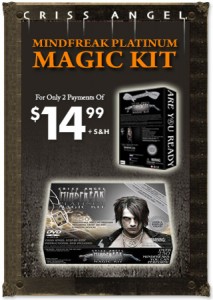
Something also tells me I’ll soon be very busy mindfucking mindfreaking people.

It's a $200 value, for Crissake!

The Keith Moon of Cats

I’d link you to the Criss Angel site so you could check out the video that goes along with this, but it has this pop-up that tries to keep you from leaving, and I have a strict policy against douchebag sites that do that, no matter how unintentionally funny they are.

I’d also like to spend more time auctioning off my kids.

He made the sign himself to attend an art show.

And I’d really like to build one of these.

I should be back once I figure out how to manage all of these things at once. Happy Holidays in the meantime.

Dec 202011
 

I’m working on a bike fit article for Bicycle Times, and would really like to gather any feedback anyone out there has regarding handlebar height. Topics I’m covering involve questions like:

  1. When you bought your last bike, was the handlebar positioned too high, too low, or just about right? Was that a road bike, mountain bike, or something else?
  2. Which affects your bar height the most: where you ride (terrain/road conditions), how you ride (riding style), or why you ride (fitness/commuting/racing)?

Feel free to comment or use the question form over there on the right to send me your thoughts, and maybe you’ll get your name mentioned in a magazine, just like Brad Pitt and Jennifer Aniston.

How-to Edition: Get $1.5M and Calculate Your Shock Rate

 Bikes, Gadgets, Swine  Comments Off on How-to Edition: Get $1.5M and Calculate Your Shock Rate
Dec 192011
 

Learning things one of the reasons I love figuring out how to do stuff like design a bicycle suspension system. I like knowing how things work–or, more precisely, it bothers me when I don’t know how things work. I’m also one of those people who learns by doing, and by having a project. I learned whatever basic programming languages and design ideas I could from needing to build a web site to sell stuff and not having enough money to pay somebody else to do it for me. Nothing motivates like a project, needing to get something done in order to make some money.

Nevertheless, there’s a lot to be said for having lots of money first. I’d often suspected the correct method for launching a new company looked like this:

  1. Raise at least a million bucks
  2. Get some friends together
  3. Try to think of something to build with the money

Now Vimeo founder and dysfunctional nerd pseudolebrity Jake Lodwick is attempting to prove me right.

Yes, Lodwick has apparently raised $1.5-million for an idea he’s yet to have. Or maybe raising the money will turn out to have been the idea itself–in a kind of meta-statement about the inherent risk of VC funding. All tech startup guys are performance artists at heart, you know. Particularly the ones who can’t code for shit.

At any rate, congratulations to Mr. Lodwick for breaking new ground in combining dubious fame with virtual productivity and value. Even the most grievous example of self-promoting human furniture hasn’t yet figured how to literally get something for nothing.

Given all the white noise around guys like this, it can be difficult to determine just how much genuine intellectual property is being created in the U.S. today, but by almost any measurement, we still think up a lot of stuff.

Still, we seem to have a lot of disco-entrepreneurs like Mr. Hoodwinked Lodwick, versus some increasingly impressive young kids in other countries who are doing some pretty amazing stuff. Consider Nick D’Aloisio, a 16-year-old kid from London whose app, Summly, has some patents pending in the way it uses artificial intelligence, machine learning and ontology to summarize passages of text. One wonders if the D’Aloisio family sedan features a rear window sticker promising “our honor student makes computers smarter than your honor student,” but, according to TheNextWeb, he’s still pretty down to earth and will be staying in school,

currently studying Chemistry, Physics, Biology, Maths, English . . . Latin, Chinese, Russian, philosophy and history

That’s right: “maths.” I don’t think it’s a typo.

It also appears he’s electing to still live with his parents as opposed to buying those stupid sunglasses and moving to Silicon Valley. It sounds twisted to even suggest, but it’s almost as if he didn’t get into the startup game for the money and fame. It’s almost as if he just likes learning and making things.

At any rate, this weekend I learned a few things myself. First, the “gingerbread” Christmas tree decoration that my son brought home from school was not, in fact, edible, even though it smelled like cinnamon (I’ve had worse food at McDonald’s). Second, I learned how to create both rising and falling shock rates in suspension systems, and how to tell at a glance whether your bike’s suspension gets softer or firmer through the mid-range as it compresses.

Falling Rate/Counterclockwise Rocker

Salsa’s new Horsethief starts off firmer, then softens up through the midrange, then firms up again toward the end of its travel. All that information is contained in the upper link seen in the photo. Seen from the drive side like this, the upper link on the Horsethief rotates counter-clockwise, tracing a rough “U” in the air. There have been plenty of bikes that used a similar suspension system, but the Horsethief and Spearfish are really helpful to study, because it’s clear just from looking at them what that upper link does. Normally impacts on the rear wheel would be driving the seat stays almost directly toward the shock, but the little link there is clearly keeping that from happening. Instead of compressing directly, the force driving into the shock is sent on a small detour, looping down before starting to straighten out in line with the shock again. That detour slows the compression of the shock and increases the leverage ratio, making the bike’s suspension softer through that mid-section. Once the link moves far enough to start bringing the force back in line with the shock, the leverage decreases and the suspension gets firmer again.

Same thing with the Santa Cruz VPP system’s upper link, which lets the leverage on the shock increase slightly once the bike is into its travel. Keep in mind you can’t generalize much past the “softer in the middle” part, because the rate of rotation on the two rockers of the VPP system creates a unique scenario, but any arc that translates the rear axle’s movement into a counter-clockwise rotation should yield a suspension system that softens somewhere in the middle.

Rising Rate/Clockwise Rotation

Now consider the DW-link on a Pivot Mach 5.7. Don’t pay any attention to the location of the shock, but check out the orientation of the linkage here: it rotates clockwise, the opposite of the Salsa. That difference generates a rising rate suspension system, or one that firms up as the bike compresses. It’s the rotation of the rocker that dictates the mid-stroke shock rate.

Which way is better? Both. It’s not that simple by any means, and there are good arguments to be made about each method. If you want to know more about what shock rate means and how it works, you should check out Santa Cruz engineer Joe Graney’s excellent article about it, but all you really need to know is that higher numbers are firmer and lower numbers are softer. There could be some exceptions to these rules, but they’d have to have some pretty funky other stuff going on, like really complicated linkages.

What do Summly and shock rates have in common? Discovery. For me, there’s nothing quite like the feeling of discovering something–particularly when it’s a scientific principle you aren’t properly educated to have realized existed in the first place. It’s sort of amazing to discover stuff in the process of trying to create something, and I think everybody should constantly push toward discovering something new that’s maybe just a little intimidating. Instead of just buying a new part to replace something that’s broken, try taking the old one apart first and looking around in there. Instead of searching for a new app, search for instructions about how to make your own. I’m a firm believer that artists should program computers and engineers should start businesses. About the only positive thing I’m sure I’m teaching my kids is that great ideas are earned by constantly trying new things.

Except gingerbread Christmas tree ornaments.

Zeitchrist: Discount Nihilism and Fuzzy Killer Robots

 Bikes, Gadgets  Comments Off on Zeitchrist: Discount Nihilism and Fuzzy Killer Robots
Dec 152011
 

A neighbor drove up next to me as I was walking the dog yesterday and asked if I was home from Chicago and if I was working. It went like this.

Me: Yes, I’m home. I’m not with the company any more.
Neighbor: So you’re just hanging out?
Me: Until I can find work, yes.
Neighbor: Are you looking for something?
Me: Yes.
Neighbor: You’ll do anything?
Me: (a bit nervously now) Well, maybe not anything.
Neighbor: You shovel snow?

Let me just here point out that this is no ordinary neighbor. He was one of the first people to walk into Speedgoat back in 1997, he’s previously owned a bike shop in Pittsburgh, and he became my landlord of many years. He let me borrow a bike stand, which I returned to him fourteen years later (actually, I couldn’t find his, so I ended up giving him a new one). He’s generally a sweet and relatively harmless elderly gentleman who happens to own not one but two original Chris Chance-built Fat City bikes.

But it always seemed to me that he didn’t understand what we really did at Speedgoat. He never seemed to see the significance of all those computers and people we had around, and I never had the impression that he understood what I did for a living. I guess now I’m certain of it.

So what did I do as CEO of an e-commerce company? Every day was a little bit like this:

Difficult to say exactly what that makes one qualified to do, though lately I’ve been thinking about going into politics.

Fortunately, I may not have to pick up a paper route or shovel driveways for a living, as humanity’s infatuation with self-destruction seems to be in high gear. For one thing, we seem to all be getting much more religious–or not necessarily “religious” in that cheesy “love one another” kind of way, but more “smite-happy” and insular. Certainly those without that lizard-brain add-on, “critical thinking,” have long since retreated into their respective god-holes by now, with only rifle barrels left sticking out. Already we missed a few rapture predictions, but that can’t stop the faithful from hoping for annihilation to be visited upon us all soon. And even among the secular, is it just me, or does it seem like we’re collectively hoping for a zombie apocalypse at this point, just to break up the monotony? Certainly, the Center for Disease Control is.

If vampires were the analogy-du-jour for the financial crisis, nothing seems to sum up the current state of the American economy quite as well as a sea of zombies, slogging through the day, unfit even for very basic janitorial duties. At this point, we’re for whatever makes us want to live again, and apparently run and scream. And maybe we’ll get lucky. Given the cost of health care these days, probably better to just let the kids go feral zombie as opposed to trying to afford anti-zombie meds. Lord knows there are plenty of people who could use a good brain eatin’, though I don’t think it’d be a very satisfying meal.

For what it’s worth, though, I think zombie is just the flavor of the week. We all really know it’s going to be killer robots that take us out.

Instead of the gleaming invincible army we’ve been led to believe is on the way, though, our robot overlords are going to be adorable!

OK, maybe not adorable, but they’ll have hair and the ability to turn their “eyes” into hearts (as they’re dismembering us). Apparently the DragonBots are all cloud connected through web connections and as one “learns,” so do all the others. Though I’ve never seen one of these and am not nearly as amped up about them as Gizmodo seems to be, I sure do hope the world ends in a sea of mass-produced tiny plastic claws. You have to admit that it’d be sort of be fitting.