Talking vs. Doing: Business and the Ibis Ripley Suspension Design

 Bikes, Swine  Comments Off on Talking vs. Doing: Business and the Ibis Ripley Suspension Design
Dec 142011
 

Maybe it’s information overload or just the campaign season blues, but lately I seem even more sensitive than usual to the constant presence of bullshit. Certainly the world of business seems carved from a solid block of it these days. Examples of “synergizing your dynamism” are everywhere, but it really pisses me off to be reading an otherwise good article only to see if slowly devolving into random spew.

A key aspect of LinkedIn seems to be keeping us all connected, not only to each other, but also to a steady parade of articles with interesting-looking titles that often have little or no value. Consider this otherwise interesting article “Five New Management Metrics You Need to Know” LinkedIn directed me to at Forbes. Overall, there’s some kernel of value in an article about more practical ways to monitor business health and performance, outside of just reviewing sales numbers, but this train comes off the track more than once. Written by Greylock Partners venture firm guy James Slavet, whose firm invested in Facebook, LinkedIn, Groupon, and Pandora, it becomes pretty obvious just how disconnected some of these people are from the daily functions of actual small business in America. Some of the article seems so rooted in bean bag chair Silicon Valley work-play as to be nonsensical to even the most ephemeral of businesses models–like “Metric 3: Meeting Promoter Score,” the idea that meetings should be evaluated to determine if they’re effective and worthwhile or not.

Most meetings suck. And they’re expensive: a one-hour meeting of six software engineers costs $1,000 at least. People who don’t have the authority to buy paperclips are allowed to call meetings every day that cost far more than that. Nobody tracks whether meetings are useful, or how they could get better. And all you have to do is ask.”

Gee, really? I guess my open mic meeting policy, where anyone could come in off the street and gather my key staff to talk about Tarantino’s Reservoir Dogs wasn’t the right way to do it. Thanks for clearing that up.

Certainly there are businesses in the world that allow idiots to call meetings that go nowhere, but do you really need to fill out a questionnaire afterward for management to realize the meeting was useless? If so, then this amazing common sense insight will be discarded anyway, because the manager is the idiot calling the unproductive meetings.

Then there’s this insightful observation about criticism and reward, or something, explained with a highly insightful analogy to marriage,

You can learn as much from John Gottman as you can from John F. Kennedy about being a great communicator. Gottman, a psychologist, is the author of “Why Marriages Succeed or Fail”.

In his research, he found that marriages that succeed tend to have five times as many positive interactions as negative ones. And when a couple falls below that ratio, their relationship falls down too.

The same is true at the office, where you’re often connected for years in relationships with people who can either become wary of your criticisms or eager to give you their best effort. Catch people doing good things. Never miss a chance to say something nice, even if you feel a little silly. Then when you have feedback on areas to improve, they‘ll really listen. It may be hard to manage to the 5:1 ratio at the office, but you should be mindful of the balance.”

First, having not read John Gottman, I have to hope he was somehow taken out of context here, though it’s hard to imagine how. So marriage partners who have more positive interactions tend to have better marriages? That’s some profound shit. Someone needs to tell the couples on the television show “Cops” that their marriages are in jeopardy.

And you’re supposed to “never miss a chance to say something nice, even if you feel a little silly.” Clearly someone needs to introduce Mr. Slavet to the term “patronizing,” which could have saved him a half dozen words, at least, thus increasing his productivity. Obviously, he’s not suggested being disingenuous, but glib shit like this dances over the actual work of management, which involves reading people and interacting with them honestly. This suggests a kind of golden mean ratio of compliments to criticisms, and adhering to that strictly would be as bad as administering only compliments or only criticism.

I made plenty of management mistakes running my own business, but if there’s one thing I did very right it was cultivate fierce loyalty, and I didn’t do it by telling people their hair looked nice.

In other business news more related to “doing” than “talking,” I think everyone who rides a mountain bike should try to design a bicycle suspension system. For one thing, you’ve probably done some bad things in your life, and this is one of the interesting methods of punishing yourself for past transgressions. That time you made fun of some other frame’s under-the-downtube water bottle position, or slightly high bottom bracket height? Trying to make your own will definitely pay you back for that.

Given that I geek out on other designs even more than usual right now, I love that Ibis has posted photos and some text about the development of the upcoming Ripley 29er frame. What’s profoundly depressing for me in studying what Ibis did isn’t just how amazing their design aesthetic or business seems to be (though they’re all ‘o that), but rather this unsettling notion: I would have kept refining it.

What the hell is wrong with me? Well, it isn’t the eccentric pivots that bother me–they aren’t that surprising to see more than one company now using, even though it’s tough to know what long term durability is going to be like. It’s the clevis, the structure that bolts directly to the shock and pivots off of the swingarm.

I love everything about the Ripley, and I love how Ibis sells and markets their products (they’re about as close to a micro-version of Apple as we get in the bike business), but even great marketing can’t take my eyes off the additional pivots on this frame. Sure, they’re not that big a deal, but why did you go to eccentrics if it tightened up your swingarm movement so much that you had to punt by delinking the shock? It seems even to go against Ibisinian design principles that have always embraced a “simplest design is probably the best” kind of aesthetic to introduce additional moving parts that have to be maintained. And it seems like an afterthought, which is weird. Ibis being Ibis and Dave Weagle being one of the only real thinkers in the entire bike business, they made great lemonade with that clevis by changing how it connects to the shock, which is great, but ask yourself how silly that piece would have looked if they hadn’t done that? You’d just be asking yourself, “Why didn’t they connect the shock directly to the swingarm?” I suspect they didn’t do that because they couldn’t, not because they didn’t want to, and that’s the only thing that bugs me about an otherwise amazing looking new frame.

Now somebody just needs to ride one.

Sell Yourself

 Bikes, Gadgets  Comments Off on Sell Yourself
Dec 122011
 

Having written about some of the stupid and narcissistic examples of “projects” on Kickstarter, it’s only fair to draw attention to the polar opposite: the stuff that’s really very good. And the most really very good I’ve seen is Twine, a tiny square that can sense stuff going on in the world around it and text, tweet or email you to let you know what’s doing on.

Note the way this project, which has raised over $300,000 so far, is the opposite of, say, a self-obsessed plea for somebody to fund you basically watching your own paint dry. Not to be overly harsh to the artistic side of Kickstarter, which does have some merit and every once in a while probably changes the world and all, but I much prefer a world in which, in order to be paid, you have to produce a good or provide a service to someone other than yourself.

Tough to say when I’ll just learn to quit bitching and take advantage of things–maybe launch a campaign wherein I ask people to contribute money in return for me letting them watch “the development of one of my blog posts, from blank page to finished work.” A five dollar contribution buys you a word, which I must incorporate into the piece somewhere. For $1,000 you can title the thing. Better still, for $15 I let you submit three random references that I will connect with an almost coherent critical thought–like The White Stripes, The Lord of the Rings, and the word “platypus.”

Somehow Meg White’s halting, simplistic drumming works because it’s stumbling along behind the almost incomprehensible talent of Jack White, a man who makes even gifted musicians look childish and insincere, and a man wise enough to know you get a hobbit to carry your rings, or play your drums. We can’t all be tigers and cobras, Meg. Even rock and roll needs the occasional platypus on drums.”

Surely, somebody’s done this sort of thing already–I mean convince people to pay them for essentially nothing. In fact, I’ve had more than one experience in business that proves it.

Twine, on the other hand, offers a product that could actually be used to do something, a product that does not leave you completely reliant on how interesting the interior of an artists head will or will not be once you’re allowed your peek inside. If you want to pay to watch people doodle, great–it’s your money–but in Twine you have a project that’s actually able to deliver a product, and a pretty cool product, too, a versatile sensor that can gather different pieces of information about what’s going on around it physically and turn that into messages for you. The artsy-fartsy aspect of Twine is simply that you have to figure out how you want to use a new kind of product, and that’s a big part of the appeal, too, but at the end of the day, you’ve contributed to the development of a product. The whole crowdsourcing applications of a new device and company developing a close-knit relationship with beta testers and early adopters and stuff makes a lot of sense for the two guys making these, but there’s also full transparency, here: they can make these things, and if you want in, here’s how you get in. It strikes me that this is how American business is supposed to work.

I’ve not yet seen an equivalent Kickstarter project involving, for instance, a new type of credit default swap or other dubious “financial product.”

At least not that I’ve found yet.

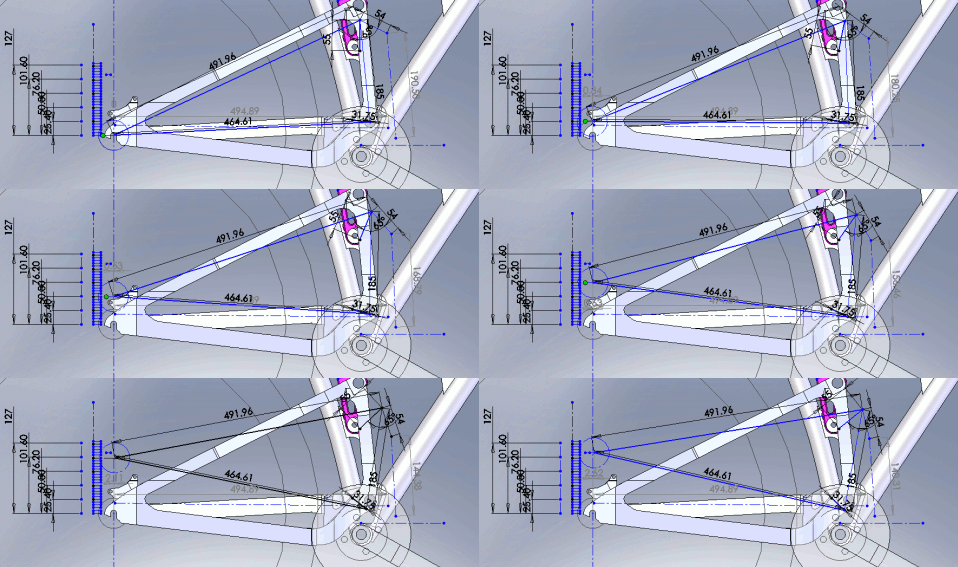
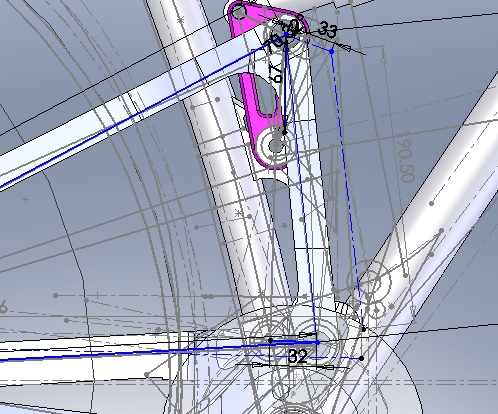
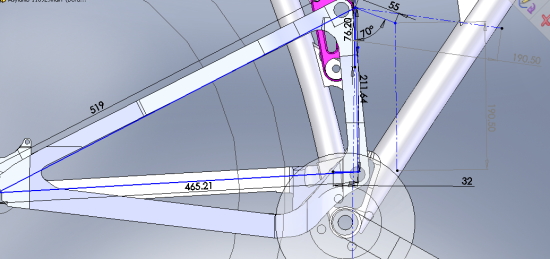
Meanwhile, my own attempts to Create Something continue to convince me I should either play the stock market or learn to grow my own food. See that nearly vertical blue 190.5mm long line toward the right? That’s the new shock position.

In order to get things just as I want them, it’s looking like I’m going to have to go with the Giant Maestro-esque “low shock” configuration, which should work just fine, except that everybody will think my design’s like a Giant, which will cause me to say things like, “Motherfucker!” all the time. Given the lower rocker position, I’m thinking about a pretty open machined triangle coming up from the bottom bracket shell. I think this could be made pretty light and extremely stiff.

Of all shock positions, the low vertical orientation turns out to work particularly well for this design, which is a little unusual. I’d initially thought a more horizontal shock was going to be the way to go, but, even though it looks like my swingarm is rocking forward, the front of it is really rocking about straight down.

Instead of being a DW-link Maestro system like the Giant, my shit actually pivots around the center of its own swingarm. Meaning the instant center is behind the bottom bracket and that I can make my rear axle move absolutely vertically if wanted it to. I don’t, but, given how much I like tire clearance and 29ers, I wanted a design that would let me get true vertical axle path and everything else that’s even close to it. I also wanted a bike that felt tight, like a dirt jump bike from the bottom bracket back.

Balancing out all the options is the biggest pain in the ass. So how much chain growth is really too much chain growth? How noticeable is a shock rate of .40 versus .43? Once I make the final decisions, I’m in for some assembly rebuilding. No fun.

I have to admit, it’d be much easier to try to get sponsored for drawing drivetrains in Steve Jobs’ head.

In Fashion

 Bikes  Comments Off on In Fashion
Dec 092011
 

There are only two universal truths in wild and wonderful world of bikes. Our professional athletes have the best psychological disorders, and the fashion industry loves us.

Not love in a “lifelong bond of mutual respect” sort of way, so much as a “some kinds of touching is bad” vibe. The most recent example was brought to my attention by Brad at UrbanVelo.com.

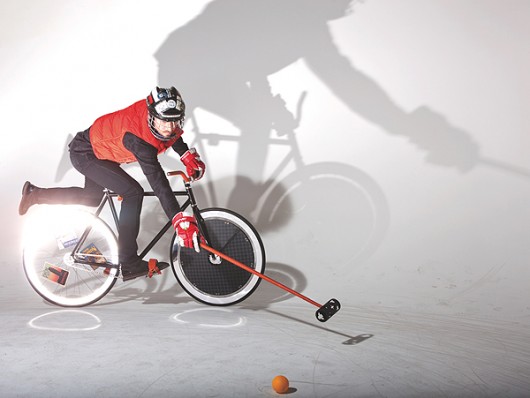
Ah, yes, designer Louis Vuitton crap for bike polo, or perhaps, based on the photos, some new combination of hockey, polo, kayaking, and croquet. The site arkitip sheds some light on the various artistic processes.

Cut to summer 2011, as we’re invited by our friends at Louis Vuitton to visit their Paris offices for a surprise. And what a surprise it was . . . They first showed us moodboards with images extracted from our bike polo fashion story, then revealed to us what they had been developing: a polo bike and a mallet. They collaborated with friends and fellow players Hannes Hengst and Grégory Barbier to manufacture an intricate and refined collection of parts. From the embossed leather pedal straps and mallet holders, to the machined chainring (by Victoire), etched barplugs, via the leather wheel cover, culminating with a spectacular hollowed out mallet head, attached to a fully wrapped shaft. All of it using the classic Vuitton patterns and shapes. I was a bit surprised to see that they decided to go for a fixed gear brakeless setup, since 99% of players now ride freewheel bikes, but beyond that was impressed by the attention to detail and the build quality.

Naturally, it’s slightly funny to read that phrase, “they had been developing: a polo bike and a mallet,” given that Vuitton themselves seem to take trademarks and intellectual property rather seriously, and that they no more “developed” a bicycle than I can download a print of VanGogh’s Sunflowers and call myself a painter.

Having just seen this same sort of thing with Need Supply Co.’s “bicycle,” I’m a little sensitive, but the thing I find most interesting about the creepy hand Fashion keeps putting on our knee is that there’s not only no substance to the infatuation, but there’s not even any genuine interest. They’re not even trying.

This is largely because so much of bicycle culture results from form following function, whereas in the world of fashion, form only follows function so that it can stab it in an alley.

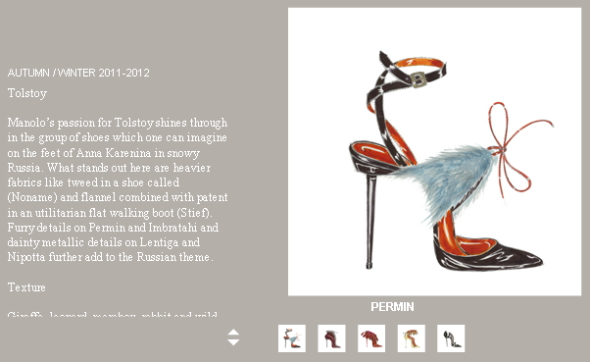
DC Shoes and Sidi should be concerned about this hip and sexy, ultra-lightweight winter adventure boot.

Manolo’s passion for Tolstoy shines through in the group of shoes which one can imagine on the feet of Anna Karenina in snowy Russia.”

All this seems particularly unfortunate to me, because here we have a fashion industry based largely on aesthetics and price tags continually drawing associations with one based largely on function, and yet the cycling industry’s only sense of craftsmanship seems to be hand-built steel frames. Recently, I mentioned that long-time frame builder Sapa is closing up shop, and why not? They made high-end aluminum frames in a market that had all but entirely moved to carbon fiber. We build satellites and we sell wildly overpriced fashions here in the U.S., so why can’t we make great bicycles? With the possible exception of Cervelo’s “Project California”, where’s the insanely expensive because of technology American-made bicycle? If something in this world can support the absurd photo shoot pictured above, and a bunch of carbon fiber bikes that cost over $10,000 and are made in China, why can’t that same market support a genuine U.S.-made super bicycle–something hand-built of barely declassified materials or using suspension designs and technology never seen before–and also fabricated with the same craftsmanship normally reserved only for steel frames being brazed in Portland?

Why can’t the U.S. build a better bicycle?

Nerdapocalypse

 Bikes, Swine  Comments Off on Nerdapocalypse
Dec 082011
 
Mythbustacapinyourass

Mythbustacapinyourass

I, for one, am both happy and relieved that the cast of the Discovery channel show MythBusters has finally launched their assault on civilized society. Sure, sure, this whole incident was just a terrible accident, a miscalculation. Right. And if you belonged to a small clan of nerd geniuses plotting the downfall of a society of morons who gave you wedgies in high-school, I’m sure you would declare your intentions to everyone instead of slowly testing weapons on the neighbors until you were absolutely sure you were ready, right?

No, it’s clear that this is game on, and that “experiments” with cannonballs are just the beginning.

http://youtu.be/Jj-CErr0VOY

Can any of us, honestly, say we hadn’t seen this coming?

In all my recent Ayn Rand bashing, I mention how funny it seems that politicians, hedge fund managers, and “think tank” wonks like Grover Norquist now fancy themselves neo-captains of industry, brilliant minds hard at work using their superior intellect to keep the world running and save us poor, incompetent middle class types from ourselves. This is partially because Rand’s “self-interest is morality” stance (the girl wore a dollar sign in place of a crucifix) is back in favor, even though it never made any sense in the first place. One of my favorite–and by that I mean “funniest”–moments in Rand’s philosophical opus, Atlas Shrugged, features the owner of the world’s most successful copper mining company going on strike against the world of stupid people who regulate his and other important businesses and joining a secret group of financially, and apparently intellectually, gifted captains of industry on a private piece of secluded land. There, he does what surely any modern day CEO or banker would do: he builds his own copper mine. Like the best and most awesome copper mine ever.

You know, like a modern day CEO or board member or company president of a major multi-national corporation would. Or Grover Norquist. There in a free-market utopia, the super-awesome copper mine he apparently somehow dug himself using magical tools and maybe that green army of dead soldiers from The Lord of the Rings movie, is free to produce shitloads of copper without worrying about poisoning the town’s water supply or having to pay fines for miners who died due to cost-cutting measures his moral self-interest led him to make. In fact, there doesn’t seem to be any actual workers in the secret Valley of the Tycoons Rand created; just a bunch of rich people for whom things just seem to happen. One supposes that when they turned their backs on the world to go rough it, they at least took the household help with them, as I don’t recall any scenes of a trophy wife having to skin a rabbit. At any rate, the home-made copper mine rocks, and everyone lives happily ever.

Describes our current situation, right? I mean, except that “CEO of multi-national corporation doing something” part. Outside the tech industry, there seem to be relatively few CEOs who can even tie their own shoes, let alone dig their own copper mines. What today’s captains of industry tend to build are credit default swaps, and there’s an excellent version of Atlas Shrugged about that, too.

Aside from lattes, we don’t make stuff in this country anymore. In fact, long-time U.S. fabricator of bicycle frames, Sapa, has just announced they will no longer be making bikes.

So if, as in Rand’s novel, the real Makers and Builders in the U.S. wanted to go on philosophical strike and quit thinking, building things for, and paying taxes to support, those just along for the ride who don’t seem to actually contribute anything to society–if all that shit really was starting to happen–where do you think the revolution would really start?

Exactly.

Nerds.

Trapped in Lockers One Too Many Times

Trapped in Lockers One Too Many Times

From computer programmers to your annoying neighbor who makes shit in his garage, and even that douchebag who invented cyclonic vacuum cleaner technology, smart people are rising up, motherfuckers. Objectivists, Tea Party types, and Occupiers alike might want to duck and cover, because I’m here to tell you we’ve finally pissed off guys like this.

At least their swift elimination of everyone else on the planet should be pretty well televised, and frankly pretty freakin’ awesome. In the immortal words of “coldunus” who left a comment on the ABC News video coverage of the cannonball assault, ” . . . this episide will be so AWESOME.”

Going Knieval on Their Asses

 Bikes  Comments Off on Going Knieval on Their Asses
Dec 062011
 

Admirable as it is to live a life free of regrets, it tends to be more entertaining to live inside an almost bottomless pit of them. Plus, you can learn from my mistakes. Here are a few things I wish I’d done.

First, I wish I’d sold products at absurdly over-inflated prices. Today’s Bikerumor.com featured this very interesting take on a “custom-built bicycle.”

"Do you find my stare penetrating?"

“Design boutique Need Supply Co. partnered with Virginia neighbor Carytown Bicycle Company to create a limited edition fixed gear city bike fashionable enough to get a shout out from GQ.

Need’s designer Gabe Ricioppo partnered with frame builder Tim Mullen of CBC to create this urban machine. Built on an All City Big Block track frame, which is designed to work equally well on the boards or your backstreets, CBC added bits from Velo Orange, Cane Creek, Continental, Regal and others as much for their looks as their performance.

Price is $2,450, available at needsupply.com.”

Yes, $2,450. As the comments on Bikerumor.com themselves point out, that’s quite a price tag, considering you’re starting with an All-City frameset that costs about $400. You could very likely buy this exact bike from your local bike shop for less than half what ironically named Need Supply Co. is charging for it. But then what kind of statement would you be making about how important bicycles are to your wardrobe life.

Silly me. Unlike “designer” Gabe Ricioppo, I only charged people regular retail price or less for custom-built bicycles. Granted, I wasn’t selling exclusively to chronically inbred royalty or trust fund hipsters, but that was probably the source of my mistake in the first place. If I ever sell bikes again, somebody remind me to grow an artisanal beard and stare dead-eyed into a camera while standing behind a Surly Pugsley I’ve wrapped in denim and am offering for $6,599.

Gabe offers some further insight into his design aesthetic as relates to clothing in an article I found by Googling his name. Here he sounds like a nice enough guy, and I’d probably like him as much I could any surfer, but the article proves the world of high fashion people clothes is just different. Case in point:

The guys who wear our clothes obviously do things, like ride a bike, and go to work.”

Sound advice. Market to people who “do things” and “go to work.” I look forward to reading the future best-selling marketing book I suspect Gabe is already having ghostwritten. At any rate, my point here should be clear. If you can’t be born a baby that shits hundred dollar bills, wish you were born this guy.

Another regret: I sold nice bikes. In retrospect, offering wretched faux-Dutch shit-mobiles with myriad festive paint options ala republic (they’re way too cool to capitalize their company name) would have been far more lucrative. Republic (that’s right, I capitalized your name there because I’m a Rebel, bitches) has been featured in Vogue, The Wall Street Journal, and The New York Times. According to their web site:

republics are built by the people Republic Bike assembles custom bicycles based on shared design. We develop designs and offer components curated for quality, value and aesthetics. Pick, choose, swap and decide and we’ll build it, box it, and ship it out. Built by us & you.”

Much like Need Supply Co., the key here, of course, is that the “product managers” at republic don’t “properly spec” bicycles; instead, artisans “curate” the component selection. This means the components found on your bike will be liberated from any bourgeois conception of “quality” or even “accountability,” and are thus free to be wildly mediocre or downright bad, but in a rainbow of expressive colors. In specing the bike yourself, you’re also taking at least some of the responsibility for bringing yet another pastel fixie into an already tired and depressed world. I’d always thought letting the customer choose the orientation of his or her King headset logo was good customer service, but I realize now that I should have literally let the customers smelt their own potmetal cranksets in China via some type of remote control robot. Then, using the motion sensor on your X-box, you can virtually slather everything on your bike in whatever unholy combination of white and magenta you can manage. I call trademark on all that shit, by the way.

But a big part of Republic’s success and recognition seems to come from the fact that happy companies apparently purchase Republic bikes by the tractor trailer load. Google never calls up a high-end shop and orders a fleet of Mooto X RSLs for their employees to cruise around the corporate campus. Come to think of it, why doesn’t Google order 12,000 Mooto X RSLs for their employees? Facebook would totally do that, and I hear they offer massages while you’re eating free sushi. Plush.

As it turns out some companies do occasionally reward their faithful employees with bicycles, often as an attempt to convince them to stop smoking and freebasing McRibs. Last year Swedish performance artist and comedian, IKEA, took a break from forming particle board into garish and unstable pre-boxed landfill and literally bought their employees over twelve thousand “all-terrain” bicycles.

Don't you wish you worked for IKEA?

“Befitting Ikea, spokeswoman Mona Liss said the bikes arrived last week in a flat box and needed to be assembled.”

Of course they weren’t assembled! Well-played, IKEA. I’ve always found Swedish comedy to be less screwball than Icelandic humor and less madcap than Finnish humor, but I have to hand it to IKEA on this one. My only disappointment is that the bikes themselves do not appear to be made of wood and held together largely with dowel rods. That would have been amazing.

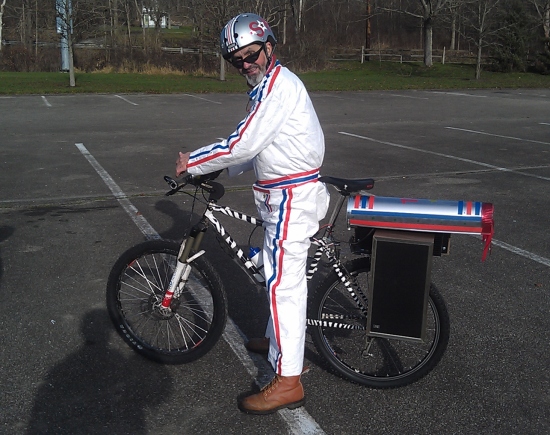
While Evel Knievel regretted not killing some people, and I don’t (yet) have to live with regrets that significant, I do wish I’d bent a few rules during my otherwise pretty boring and upstanding time in retail. I wish I’d sold products primarily to corporations. Corporations are the new people anyway, so I think everyone should be focusing marketing on the 20-60-year old corporation dynamic. That’s where the money is right now.

You have to throw a few eggs at the neighbor’s house if you want to make an omelet, though. In the bike business, for instance, there are things one is allowed to sell on-line, and then there are things one is banned from selling on-line. Ever. And yet, reading this article I found recently at Inc.com, one wonders if shipping Trek bikes to customers–the most forbidden of dances in the cycling industry–was really forbidden after all. It certainly didn’t appear to be for successful entrepreneur, Chris Zane of legendary Zane’s Cycles in Connecticut. In particular, this section drew my attention:

More than a decade ago, he used that concept to launch a business filling orders for custom-fitted Trek bikes geared for corporate rewards programs. He has sold his bikes to credit card companies for their rewards programs and corporations who offer them as employee incentives. Zane’s Cycles builds the bikes to specification, and all the recipients have to do is attach the front wheel, using the included instructions. The end goal: Creating experiences that will make customers feel good about the reward product—and not irritated that they have to spend hours putting something together.”

Um, OK. I reread that three times, but it kept seeming to tell me the same thing: somebody made a business out of shipping Trek bikes to people. Again, as rules go in the bike industry, selling Trek bikes on the internet is roughly akin to marrying your sister and holding the reception at a puppy shooting range, and I once got in trouble for having two sets of Bontrager tires show up in my web catalog. So maybe if this business was really shipping Trek bikes to customers, then it was only a few here and there, under the radar, that sort of thing. Only $15,000,000 a year in sales, or three quarters of Zane’s sales.

According to the article at Inc.com, Zane’s corporate rewards program business apparently counts for three quarters of his $21-million–yes, bike shop owners out there, twenty-one-million–in yearly sales. That suggests the bike shop itself is making a little over $5-million a year, which is certainly outstanding, but, given that this income is dwarfed by the sales numbers of the shipped bikes, I don’t know if it’s fair for the author of the article to conclude: “He’s come this far with the help of store policies that would make big box stores blush: Lifetime service guarantees, 90-day price protection, and a trade-in program for children’s bikes where parents get 100 percent of the purchase price applied to their child’s next bike.” Those are certainly wonderful consumer-centric values, yes. Very Zappos. But I think it’s more likely the business he built shipping Trek bicycles to corporations–the business that makes up three quarters of his sales and one strictly forbidden to every Trek dealer I’ve ever known–might have had a semi-important role in his success.

Don’t get me wrong. From what I’ve seen, I like Chris Zane. He seems like a nice guy, and I honestly believe the world would be a better place if his philosophy of service over product was indispensable for all businesses. I’ll bet his book is interesting, and I share a lot of his service experiences (I, too, have driven bicycles to customers’ homes after hours, not to mention picked up customers’ bikes for repair work and driven thirty miles to deliver a bike rack). But, if the article is accurate, I just can’t get past those numbers. Again, owning a bike shop that’s pulling in over $5-million in sales is no small feat, but generating almost $16-million putting Treks in boxes when no one else is allowed to seems to be the real growth story here.

In fact, it could be that rules are more like “suggestions” in the bike industry, and, if that’s the case, then boy, I regret not having broken some of them. And, sure, I also regret not killing a few people. And that jet car over the canyon thing. That was just stupid.

Descent into Mudness: Punk Bike 2011

 Bikes  Comments Off on Descent into Mudness: Punk Bike 2011
Dec 052011
 

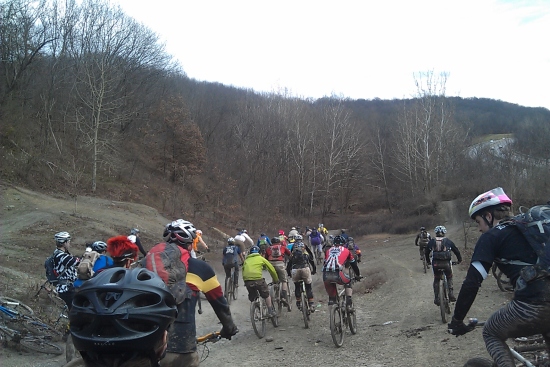
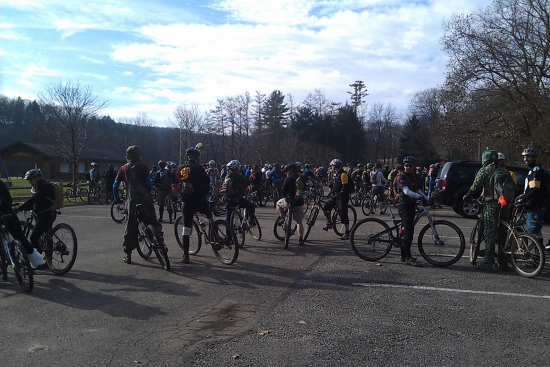
Some philosophers believe pursuing a personal ideal while at the same time recognizing the ideals of others is one way to achieve a meaningful life. Others suggest meaning derives solely from attending Dirt Rag’s annual Punk Bike Enduro. Having all but given up on the former, I was at Punk Bike yesterday.

If there’s one thing cable news has taught me (I mean, aside from the value of hoarding gold), it’s that there’s absolutely nothing wrong with wildly guessing at attendance figures for public events, so I’m going to estimate that 42,000 people attended Punk Bike this year, partly owing to the exceptional weather.

By “exceptional,” I mean “warm.” Living in Southwestern Pennsylvania, we are all, however, subject to a special clause in the laws of nature stating that any seemingly positive natural phenomena must be met with an equal or greater adverse phenomena, like locusts or land sharks, or in this case, mud.

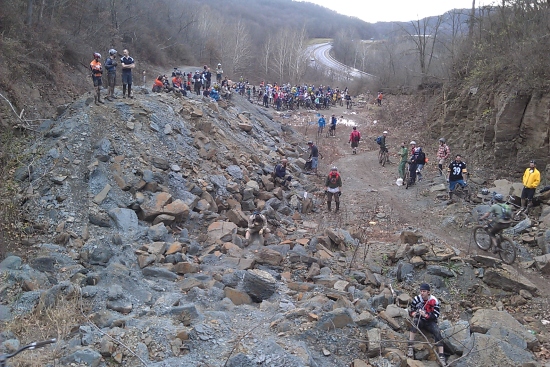
Turns out, there’s a very good reason why I should have taken the rigid single-speed like everyone else. You’d think I’d be used to real PA mud, given that I live here, but it’s all rocks on top of rocks around my house, so I was woefully unprepared for the adobe of mulchy leaves and thick goo just north of the city proper, the kind of muck that collects between frame and chainstays and brings you to an absolute halt. What few moments I was actually able to pedal my bike were gloriously wonderful and occurred to the soundtrack of ten thousand leaves buzzing along in the bowls of my lower rocker. On the upside, my full rear wheel lockup downhill bike skiing skills improved marginally by the end of the day.

Add frequent motorcycle use in the area, and that means some ruts were also considerably deeper than pedal height. None of this deterred the n’ere do wells who showed up, shown here launching off on another stage.

The best parts of the course consisted of puddles of unknown depth at the bottom of uncontrollably slippery descents. This made for great riding, and pretty great “course marshalling,” too, which let me study various techniques.

  1. Full-tilt and Straight Down the Middle – the best option

  2. Full-tilt and Let the Flora Get you Stopped – bolder, but ultimately slower

  3. The Only Been in Pennsylvania a Week – disc brakes perform a different function here than they do in Los Angeles


    The bike actually came to a stop like this, as if awaiting repair.

Not captured here was a pretty spectacular split that resulted from an attempt to walk the bike down. Definitely safer on the bike.

Er, usually.

Brutally muddy as they were, the trails were extremely fun. Though some of the hairier descents might seem less exciting once I have some semblance of control over my bike, I hope to make it back here during a dry part of the summer.

As great as the trails were, though, everyone knows you come to Punk Bike for the people. And the things that are almost like people.

The vikings.

Ironicly undersized 26" wheeled bikes are the new coaster brake clunkers in Norway.

The Amish.

Little known fact: I actually did have a Mennonite test ride an Ellsworth once, and the boy had serious skills.

The demonic.

"Front brake." Yet another use for capes is discovered.

The decorated.

Admit it: helmets beg for this sort of adornment.

The disco pimps.

Everything about this look is perfect.

The festive.

Streamers make everything better.

The CHiPs.

This is John, but Richie Rich from NoTubes as Ponch was pure magic.

The sporting.

(insert your own favorite joke about "balls" here)

The unnaturally Scottish.

And he's OK.

The professional.

"You're gonna like how you look."

The cryptozoological.

Many people we encountered in the park found our group interesting.

The awe-inspiring.

All Sleestak listen to Danzig.

Some of the nicest people in the world attend Punk Bike, where they begin the day by crashing into one another until there can be only one, like the Highlander.

Derby time.

All of these cats were admirably herded by Super Dave Osborne Dirt Rag’s own Karl Rosengarth, who kicked the day off by kicking out the jams.

The worst part of living on a mountain in the middle of nowhere is, well, the goddamn rattlesnakes–but the second worst part is rarely getting to see some people I really like, including everyone at Dirt Rag and some old friends. One of the first people I saw at Punk Bike was Dan, a great guy who owns this amazing, classic Smorgasbord. I built this bike myself a long, long time ago.

Man, I miss this Smorgasbord.

Punk Bike gave me a chance to catch up with so many good people. I even got to ride with slide around while watching Dave Krack speed through the woods on a bike with one wheel more than he usually has and some custom headwear.

Lots of good people, but only one of them teaches others to unicycle. (Hint: there's a turkey on his head.)

It needs be mentioned that amidst all the merriment there were two accidents at this year’s Punk Bike, which gave the evening a slightly surreal and gonzo quality. One minute I’m slithering down the last descent on the day and the next, I’m watching a man dressed as a sleestak escort a paramedic up into singletrack while a helicopter circles overhead. After a relatively uneventful day, all of a sudden the last hour of the ride took on a kind of The Hangover meets Apocalypse Now quality, which included some possibly cracked ribs, two squad cars, one ambulance sunk in mud, a high-speed crash into a guardrail, a helicopter landing on a rugby field, a second ambulance, and a fire engine to tow out ambulance #1. Before the evening had ended, Maurice offered a positive update on the riders, and our thoughts go out to both. Fortunately, seemingly one out of every three riders at Punk Bike is a trained nurse, so in both cases a highly trained individual was on the scene immediately. As unfortunate as both accidents where, it’s situations like these that bring out the true character of Punk Bike. There’s really no better scene to sum up the Punk Bike experience than exhausted (and in some cases utterly knackered) mountain bikers in ridiculous costumes instantly abandoning their own bikes and their own thoughts and concerns and rushing to the side of someone in need.

Would we all do this even for the new guy from LA? Of course we would. He’s one of us now, and if you see him on the trails, please help him out.

Vertical Integration

 Bikes, Swine  Comments Off on Vertical Integration
Dec 012011
 

At market close today, Lululemon’s stock was down over 5%, after having been down more than 11% earlier in the day. I don’t mention this to suggest I had anything to do with it, but I did. Everyone knows that most savvy investors make decisions based on three things:

  1. The weight and type of fish CNBC Senior Economics Reporter Steve Liesman has caught most recently.

  2. A complex algorithm involving the peaks and troughs of bite patterns produced by Warren Buffet.

  3. Shit I type.

How fortunate for anyone short selling stretchy pants that I was so direct for once. Usually, the big players on Wall Street have to guess what I’m talking about after first decoding all kinds of whiny bullshit about bicycles and bad people. Which reminds me, here’s what’s really going on with the financial crisis in Europe:

But I’m not the only one sending messages. Turns out “comment spam” is one of the negative side-effects that comes with flinging rants and random thoughts out over the interwebs. The funny thing about comment spam is that it has to be written in a general enough way to apply to any subject whatsoever, and that makes it pretty funny to read. Here are some examples (typos have been left in, because they seem to be intentional attempts at authenticity):

  • “What I find so interesting is you could never find this anyrwhee else.”
  • Yes, I too find that interesting, Mr. Spam. We should get together and talk about how one person’s thoughts always seem to be slightly different from everyone else’s collective thoughts.
  • “We’ve arivred at the end of the line and I have what I need!”
  • Still comically vague, but also kind of ominous, that one. Makes me feel like I just rode the subway with Herman Cain.
  • “Time to face the music armed with this great infmroation.”
  • Yes, by all means, change your life based on some shit somebody you don’t know posted on a blog.
  • “Great cmmoon sense here. Wish I’d thought of that.”
  • You know what else if common sense? Spelling the word “common.” I’m not aware of any keyboard in which the “m” key is easily mistaken for the “m” key. Seriously, go ahead and try to type “cmmoon”: it’s barely possible when you’re trying, let alone possible to create by accident.

I delete these because they’re obviously junk, but does anyone out there know why people send these? They don’t seem sophisticated enough to be trying to dig their way into databases, and even if they did, I don’t have any useful information anyway, because I’m just writing a stupid blog. What are these things supposed to accomplish?

And what am I trying to accomplish? Another week spent crunching shock rates to no avail. I’m not sure why I keep being attracted to shit that’s not easy, but I need to knock it off. I do believe I’ve narrowed possible options down to a vertical shock position, though, so the nearly perfectly vertical blue line here is my current projected shock position.

Might mean I’m going to have to get my Giant Maestro on and go with something like a pierced downtube, but I’m thinking it would be no big deal to expand the machined part that houses the lower rocker (I’ve been calling this the “crankcase”) to include a lower mount for the shock. It’s possible that could be a single machined piece, which should be pretty light and should be able to create a huge surface for a not-too-hairy miter and lots of weld bead surface. We’ll see.

The Benefits of Exorcising

 Bikes, Swine  Comments Off on The Benefits of Exorcising
Nov 302011
 

Recently, I was a bit critical of Lululemon’s corporate crusade to find John Galt. Not to be outdone by little old me, the Catholic church, barometer of all right and wrong, has just declared yoga to be Satanic–or, more specifically, former Chief Exorcist for the Vatican, Father Gabriele Amorth, has reiterated the Papal stance on the matter. Though I’d grown up Catholic, I had no idea we even had a “Chief Exorcist” on the team, let alone one whose favorite movie is The Exorcist and who’s apparently seen people “vomit shards of glass and pieces of iron.” Given that Father Amorth declared both Yoga and the Harry Potter franchise Satanic while introducing a new movie about exorcism starring Anthony Hopkins, one has to wonder what other rockstar demon-battling superstars the Vatican has had on board all these years. I’d like to think that the few dollars I put in the collection basket all those years went to the development of some bitchin’ bladed throwing crucifixes!

Speaking of all-powerful nation state institutions, Specialized Bicycles seems to have run afoul of Bell Sports, the crew who owns Giro, Bell, and Easton, after perhaps one too many mandates that a shop not sell Bell products or risk losing Specialized dealership status. In case you missed that, Specialized actually does not permit retailers to sell certain other brands. In fact, it’s extremely common. Trek has similar policies in place as well. As the co-800lb gorillas in the retail bike market, these two companies have been left largely unchallenged for years while dictating to helpless independent bicycle retailers just what their inventory is supposed to be. Understanding how this can happen begins with understanding that, in the bike business, “independent” doesn’t mean “free” so much as “without any representation or protection.” Similar parasitic relationships have gone on in this industry for many years.

The irony here of course is that the red-blooded Assos wearing free market capitalist just now taking delivery of his $18,000 Specialized McLaren Venge is usually completely oblivious to the fact that the small business owner who sold him the bike did so with a gun to his head.

But who cares? It’s good business for a company that can leverage its market share to do so every way possible, and why would Specialized and Trek sit on their hands and wait for randy upstarts to engage them in hand-to-hand sales combat when they can carpet bomb the whole industry with regulations from 30,000-feet and keep the competition off the battle field to begin with? It really is better to avoid competition than to take any chances. Especially when you’re producing a superior product–and who can question the superiority of your product if nobody gets a chance to ride anything else? Fair market competition is obsolete once you’re proven you have a superior product by ensuring there is no fair market competition. All the Chosen Ones need to do now is send out some promotional “Who is John Galt, Baby?” bags to their hamstrung retailers.

Alas, one major problem with maintaining a monopoly these days is something called the Internet, which tends to distribute information to people, and has proven extremely resistant to the kind of control guys like Specialized can exert over independent retailers. Though you can buy visibility with flashier web sites and ads, even the largest company ultimately can’t keep people from finding out about competing products on the internet, and, regardless of what anyone tells you, this is one of the reasons you won’t find retailers offering Trek and Specialized products for sale on-line. As long as there’s a virtual monopoly still in place with the antiquated sales structure of bicycles, the guys on top are going to stay on top, and the status is going to stay plenty quo. Now more than ever, though, the Internet is disrupting that model, and the cycling industry is scrambling to adapt to the shake-up. Consumers are researching and buying their products on-line, and that’s going to be increasingly true in the coming years. There comes a point at which ignoring e-commerce will begin to dismantle companies like Trek and Specialized, and we’re almost there.

Consider that Specialized is now selling some products on their web site, and, regardless of what half-assed “payment sharing” plans such direct e-commerce sales claim to offer local dealers, you have to be a complete idiot not to see moves like this for what they really are: attempts to embrace e-commerce without ceding any control to the front-line retailers representing your brand. The much touted line that independent bike shops are completely safe because nobody will ever purchase an expensive bicycle on the internet is a pacifier, stuck in the mouth of the independent bicycle dealer by that brands that don’t know how to handle sales of their products on-line. Ask Competitive Cyclist whether anyone buys high-end bikes on-line. Or any of the other on-line retailers banking over $20M in yearly sales. Does anyone really think a Competitive Cyclist-built custom bicycle arrives at a guy’s house looking like an unbuilt Ikea desk, and that the company has experienced off-the-charts sales growth over the last handful of years because they keep disappointing customers? I owned a company that sold bicycles on the Internet, and I’ve personally exchanged over 80-emails with a single customer regarding a bike purchase–plus those products don’t put themselves up on your web site and if anything customers have far more questions for which they expect real-time answers, even at 2:00am, so the argument “these web guys” have “no overhead,” is a myth perpetuated by the same guys forcing you to increase your pre-book by 10% next year. The IT spend alone is staggering. These places have extensive overhead; it’s just a different type of overhead, and one that some of your brands don’t want you even sniffing around at. In fact, the industry has been so turned around that many retailers see the Internet only as an enemy, not an opportunity. Long term, that will prove to be tragic. Am I saying the e-comm guys have it all figured out? Not at all. Many of them don’t have a clue, and that’s why it’s important for local dealers to at least understand e-commerce as an opportunity. Local brick and mortar dealers have been fed a load of bullshit about the Internet for years, and when the guys who keep you from selling their products on-line start selling them on-line themselves, it’s time to wake up.

By the time you’re throwing up glass and iron, even Father Amorth won’t be able to save you. Might as well open a yoga studio.

Thanks Giving

 Bikes, Swine  Comments Off on Thanks Giving
Nov 282011
 

At some point during my turkey-induced lethargy over the past few days, the notorious Dirty Dozen took place in Pittsburgh, an event wherein cyclists seek out the most absurd climbs in the Pittsburgh area and ride their bicycles up them. Once upon a time, I sponsored a talented young man named Montana Miller, and this year he broke course records for running a 36×17 gear combination for the event. I’ll let you contemplate that for a while as you stare at this photo, taken by Jon Pratt, of Montana taking care of business.

36x17, bitches.

Montana is a fine writer, and little bit like a real-life action figure, which makes following his adventures worthwhile.

Speaking of poets and super-men, if only Friedrich Nietzsche could have lived long enough to see his work help Kanye West side-step a lawsuit. For me, the most interesting part of the entire article is that another rapper rhymed “stronger” with “wronger” and referenced Kate Moss, but the Nietzsche assertion that “what doesn’t kill you makes you stronger” is also pretty fun to imagine as the meme du jour for corporate and wanna-be corporate pop stars.

And what is it that guys like Kanye and other corporate Movers and Shakers are made stronger by enduring? Why us, of course. Mediocrity.

And you know who else grows stronger just from having to tolerate our pathetic existence? Chip Wilson, the founder of yoga retail powerhouse Lululemon, whose company has begun printing the catchphrase from my girl, Ayn Rand’s Atlas Shrugged on the company’s shopping bags.

I don't know, but I'll bet he looks good in yoga pants and an overpriced hoodie.

The funniest part of all of this is the dippy, new-age self-empowerment spin Lululemon’s trying to put on Rand’s decidedly un-zen-like philosophy of personal gain at all costs. The company’s blog page has this to say about the bags.

Our bags are visual reminders for ourselves to live a life we love and conquer the epidemic of mediocrity. We all have a John Galt inside of us, cheering us on. How are we going to live lives we love?

Yes, how? Surely not by thinking about others–or even acknowledging the existence of others–but rather, by being really fucking thankful we were born into enough privilege to afford $68 yoga mats and dime store philosophy, easily digestible by the Kardashianic masses.

Well, almost. I have to admit that, as positive self-affirmative aphorisms go, I don’t get this one–and yes, this is really something that’s actually written on one of their bags: “Children are the orgasm of life. Just like you did not know what an orgasm was before you had one, nature does not let you know how great children are until you actually have them.”

Holy shit.

But as frankly tone-deaf and disturbing as whatever-the-fuck that was supposed to mean might be, Lulu’s recent evocation of the Great Capitalist Virgin/Whore Pin-up Girl, Rand, is just a touch more disturbing still, because it confuses Rand’s philosophy with innocent snake-oil self-empowerment nonsense. The almost beautiful irony here is that Chip Wilson’s philosophy for Lululemon is to “elevate the world from mediocrity to greatness.” Granted, that’s probably as much bullshit as his sea-weed powered fabric, but it does fit within the bounds of Rand’s philosophy. The part that nobody likes to talk about with Rand, though, is that there are losers. Lots of them. Probably about 99% of the world. And still more important: at the end of the day, Rand is writing a justification for spoils that went to a victor for, well, some reason–that’s where fiction can be really convenient. One guy is really good at copper mining, which is clearly a skill one is endowed with at birth, and like Galt’s magic engine that runs on virtually nothing, Rand doesn’t care to go into details about how these people came to acquire this knowledge.

Presumably, there were just born that way. Better. And preternaturally disgusted by the stink of mediocrity all around them.

See where this starts to build some friction against the idea of self-empowerment? Like enough friction to power a magic engine its own self? The joke is that it’s a caste system. It’s closed to most of us. Who is John Galt? Not you, pal. In order for Rand’s philosophy to work at all, the whole concept of self-improvement has to be eliminated as an option.

Me, I want to be a guy who finishes designing a suspension system for a bicycle, and I believe Malcolm Gladwell’s right about proficiency requiring about 10,000 hours of energy. Why? Because I believe whichever intellectual has better hair, and Malcolm’s mad genius thing absolutely smites Rand’s “the logical purpose for hair is to protect your head from the sun, even if you never go outside” vibe.

But the most amazing thing of all is that we live in a world where a guy who made his fortune selling overpriced yoga clothing can claim to be “elevating the world from mediocrity to greatness.” That such an idea can exist–even as marketing–suggests our whole scale is off. It suggests, ladies and gentlemen, that the people flying Rand’s flag are not, in fact, the doers and the makers of the world, but those looking to explain their absurd success to themselves.

People like Dean Kamen and Dick Proenneke can make and do things, and maybe there are even some Ayn Rand fans out there who can actually do something, too. Here’s how I can usually tell: someone capable of actually doing something may talk about him or herself, but seems to really be speaking about everyone; someone who’s never truly created anything–maybe not since sixth grade–tends to talk a lot about everyone, but always seems to really only be talking about himself.

Anyway, still working on shock rates. I’ll leave you with a photo of my other favorite Lulu, which pretty much exemplifies life inside your own privileged bullshit bubble.

Survival of the Unfittest

 Bikes  Comments Off on Survival of the Unfittest
Nov 262011
 

After a few days eating turkey and banging my head against my keyboard, I realize I’ve officially entered the “negative obsession” phase of work on my suspension frame, wherein there is nothing even remotely enjoyable about the process and yet I keep working on it pretty much relentlessly. In some ways, the 2007 me who developed the concept for this and put through the patent on the design did 2011 me a huge favor: I have a cozy little intellectual property bubble within which to work away refining things. Nevertheless, I’d very much like to punch 2007 me in the throat for making that bubble really little and apparently out of steel, which makes for a design that’s apparently impossible to finish. All I need now are some acceptable shock rates and a slightly less Dr. Seuss shock position, but that’s seeming hard to come by. Many times, I’ve come really close, only to hit a brick wall and have to redesign everything from the ground up.

Endless revision makes for a lot of lines.

So I called a time out today, oranged up to reduce drawing friendly fire, and took the ‘cross bike out for a while–and I’m glad I did, because I actually encountered an exotic species of Mountain Hipster, a smiling guys on lugged steel bikes, one wearing a plaid cap in place of a helmet. They’d just climbed the back road up the mountain and had four miles of poorly graveled road to look forward to before heading down the sketchier Route 30 descent back into town. I’ve seen bear, porcupines, rattlesnakes (too many), foxes, giant-ass-snapping turtles, and turkey vultures up here, but I’ve never seen anyone on a lugged bike with a jaunty cap. Good day.

Halfway down to the spring where I was filling up the water bottle before heading home, I passed Brian, a friend, dedicated racer, and owner of many nice bikes. He had the titanium Indy Fab ‘cross bike out, and we ended up riding back up the mountain together. This was a complicated process for me because:

  • I am fat and weak
  • Brian is insanely fit–fit way beyond just racing bicycles fit. Fit
  • We had plenty to catch up on, which meant talking while climbing
  • See #1 above

Before getting back to a batch of tech questions I need to answer for Dirt Rag and the next 1,000 hours I need to spend trying to design a bicycle, I’ll share a tip I have for climbing while having a conversation with someone approximately seventeen times more fit than you are: the key is something I call asymmetric conversing, and it goes like this:

Superfit Racer: “Have you talked to George lately?”

Fat Weakling: “No, no [with feeling].” (Note: minimum syllables and air required to produce those sounds, and the “with feeling” part says, “But have you? Please tell me about it?”)

Superfit Racer: “He’s doing pretty well. I usually talk to him about once a week.”

Fat Weakling: “Wife good?”

Superfit Racer: “Yep, they’re getting situated in their new house. Have you had any bites on the building in Laughlintown? Is it still for sale?”

Fat Weakling: “No, no [again, with feeling].”

Superfit Racer: “So anything you’re working on right now?”

Fat Weakling: “No. Do you believe in God, and why?”

See that? The key is to breath as much as possible by keeping the fit friend talking as much as possible. Think tennis: the more time the ball spends on the other side of the court, the better off you are. It’s simple survival.

And speaking of survival, I’d previously mentioned my idea for a truly tough, Tough Mudder event, but having found out about a guy named Dick Proenneke, I’d like to revise that. Keep your sissy heart rate monitors and tribal tattoos: my newest idea for a competition is to see who can build his or her own cabin in the Alaskan wilderness and live there alone for thirty freaking years. Anything less, and you’re a pampered little bitch.

I call dibs on producing the series, and the celebrity version, so no funny ideas, Mark Burnett.