SRAM gave a bunch of parts to different artists, and this is one of the more, uh, interesting creations.
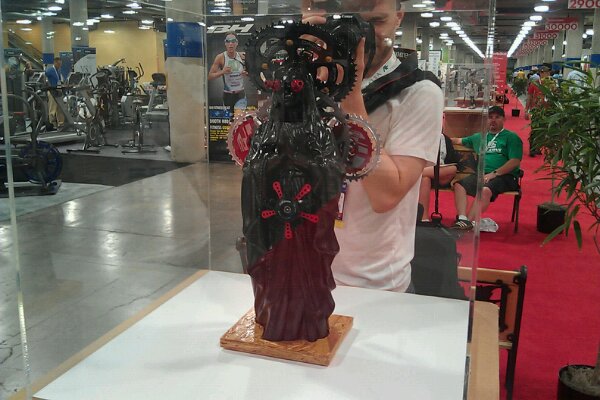

SRAM gave a bunch of parts to different artists, and this is one of the more, uh, interesting creations.
Breakfast with the guys from Pivot, then we created this ominous rolling mob of black umbrellas. Wal-greens sold a lot of umbrellas this morning.

I was prepared for the filth, but not the rain. Got me there, Vegas.

Interbike coverage starts September 14th, but there’s still time to submit questions and requests about new products. I’m there to be your eyes and ears, and knees and elbows, too.
Question: I had an old Gary Fisher with a press-fit bottom bracket, and replacing it was a crazy pain in the ass. (Plus it was basically just two bearings, and the bearings were garbage so everything had to be replaced every couple years.) Now I see this horrible idea resurfacing like a bad hippie flashback. Is this just retro stupidity, or have things actually gotten better?
Answer: 
Gary Fisher really is a visionary, it’s just that at some periods in his life he was wearing those little, diamond-shaped, red-tinted glasses, and some things weren’t entirely in focus. Seriously, he never stops trying to build a better mousetrap, and he was painfully ahead of the curve on some things (bottom-brackets, sure, but also oversized head tubes). Pushing forward on standards causes plenty of headaches, but sometimes it makes for breakthroughs. For a while there around 2003, Trek seemed to be relegating Fisher to a tent out in the back of their real offices, until everyone started shopping at the tent (remember Trek’s STP vs. Fisher’s Sugar? Trek’s 69ers vs. Fisher’s 29ers?). The guy knows stuff.
So there was a logic to that first attempt at an alternate kind of bottom-bracket, but you’re completely right in hating those things. They were awful. Compared to what we have these days, those original snap-in bearing systems were not good.
Current systems are pretty good, though some of the same problems remain. The first problem is compatibility: when a new system is introduced, it creates problems for replacing parts. We have so many different “standards” on the market simultaneously right now, that it’s tough even to know which bottom bracket fits your new frame, let alone how good it is. Here’s a quick list of the most common ones:
Basically, we’re going bigger diameter and wider in everything, and the bigger diameter and wider shell make for a stiffer crankset, which really does improve your power output. But the increased size also allows us to get away with designs like the press-in system, that we previously couldn’t, when sizes were smaller and materials were inferior. Almost any system you go with these days is going to perform better than previous designs, and be more reliable as well. The evolution wasn’t always smooth or direct, but, overall, these new systems are better.
Interbike 2011 is about to get underway, and I’ll be there asking questions like “When will we actually see these at dealers?” and “How drunk were you when you designed this?” What with Eurobike just ending and Interbike just beginning, we’re all focused on seeing the latest stuff.
With that in mind, here’s a preview of some products we might be seeing–not at this year’s Interbike, but a few years from now. Think of this as the bike version of seeing the new Nike McFly. Some of what you’re about to see may never come to be, but some will, and all of it’s interesting. Finding this information is possible thanks to my extraordinary powers of prognostication, but also thanks to publicly available patent information anyone can access any time.
I don’t know if Specialized will ever produce products using this patent, but they’ve had these plans to integrate shifting and suspension since 2006. As a guy who still dislikes anti-lock brakes, I tend to hope this stays on the shelf, but who knows. Maybe they could do something incredible with this.
There are plenty of weird things out there in Patent Land that aren’t yet attached to a company with the resources to see them into production, and this could be one of those, but I get the feeling we’ll see this actually hit the market at some point.
Difficult to say exactly why Trek would have filed a patent application for a suspension fork in February of 2010. If it’s an attempt to make inexpensive forks for entry level bikes, you’d still think they’d just license something–and they sure wouldn’t put Jose Gonzalez and Greg Buhl, the guys behind anything serious going on with suspension designs at Trek, behind this project.
No, I don’t think Trek is muscling in on Shimano and SRAM’s turf, but this suggests the boys in Wisconsin are dedicated to their Active Braking Pivot frame design.
Though it sure seems to pay homage to the classic Moots circa Kent Eriksen YBB design, Calfee’s design for a soft-tail looks distinct, cleanly done, and really intriguing, and it’s certainly possible we’ll see bikes using this design soon.
It’s certainly possible this fork will never see the light or day, or worse–that it’s intended for a hybrid. Shimano already shows fork patents that seem suited to light duty use, but this thing looks a little sophisticated for a trip to the grocery store. In addition to this patent, the same drawings appear in a second patent that details a process for transferring air between two different chambers using a lever, which gets really interesting, once you’ve seen the third patent, filed in April of 2008, that seems to show a dual remote system for managing both travel and damping (Fig. 2 below), or their external reservoir electronically controlled fork damping system.
Okay, so we probably won’t ever see this thing, and maybe it’s for the better, but part of me sure hopes it surfaces somewhere, somehow. Probably won’t be at a show, though. Interbike has become so incredibly expensive for the exhibitors these days that you never see insane, goofy shit like this anymore, and that’s truly sad. Here’s to you, dual-shock, elevated combo-chainstay-linkage design.
Maybe you’ll see it one day. I’m working on having a prototype built now. Feel free to submit questions about it using the question submission thing up at the top of the page, there on the right.
An excerpt from this patent application, filed in 2009, suggests the use of a “thermoelectric generator” that would use a magnet passing coiling wires during movement of the shock to activate a cooling device. Another, even wilder, possible embodiment introduces something called “piezo electric crystals” that would generate electricity when under compression. In all cases, these “TEGs” or thermoelectric generators, have the ability to literally move heat around, and that alone is pretty insane. By the time the application starts suggesting the TEGs can “based on the Peltier Effect and correspondingly constructed from thin ceramic wafers having alternate P and N doped bismuth telluride sandwiched between them,” I’m willing to just give Fox the benefit of the doubt and believe this crazy bastards are really serious about making suspension systems. I mean holy shit, guys.
The examples go on, and now that you know where to look, please feel free to roam around all up in the patent club. I haven’t even mentioned some really interesting suspension designs. Good, bad, or ugly, these patents are all proof that we belong to an incredibly creative and innovative industry.
Question: I see pictures of gorgeous carbon bikes from Santa Cruz and Ibis and everyone else, but I am neither svelte nor graceful. How fat is too fat for carbon fiber?
Answer: A few companies–most notably road wheelset manufactuers–do list recommended weight limits for specific products, but most frame manufacturers tend to side-step the issue with ambiguous wording, or no information at all. Current carbon fiber frames do have the potential to be stronger than metal frames in almost every way. The traditionally bullshit marketing term “stronger than steel,” is actually true when it comes to carbon fiber; it really is incredibly strong, and its basic construction method tends to be very reliable and extremely consistent. You can put exactly as much material precisely where you need it on a carbon fiber frame, and that precision makes for huge improvements in strength and stiffness. Most clydesdales assume carbon fiber is going to be weak and flexy simply because it’s so light, but even crazy-light frames like the Santa Cruz Blur XC and Tallboy genuinely feel stiffer and more solid than their aluminum counterparts. So modern carbon fiber (unlike the Scott Black Magic handlebars I broke every third ride in the early ’90s–they would keep warrantying them for as long as your suicidal tendencies persisted) is very good. In fact, the only area in which a well-made carbon fiber frame is at a disadvantage to more traditional metal frames is impact. With a few glaring exceptions carbon fiber can’t take a punch.
In most cases, the real question isn’t, “Do I weigh too much for carbon fiber?” but rather, “Do I crash too much for carbon fiber?” And it’s not only how often you crash, but how unpleasant those crashes tend to be. There are many shades of “not graceful.” Classifying yourself based on your last three bails will tell you more about the lifespan of your future carbon fiber frame than your weight alone will ever reveal.
Figuring out which specific type of trainwreck best describes your riding can be done using personality tests like the Minnesota Multiphasic Personality Inventory or the Myers-Briggs indicators, but looking around on the Internet, I found an even better personality test called “Character Alignment” from an organization called Dungeons and Dragons. Here’s a simple guide to help each of us determine his or her own level of personal destructiveness.
You mostly only hurt yourself.
Carbon Fiber for you? Might as well.
Bonus points for: Sand
Ambivalent about authority, but not capable of achieving “damage velocity.”
Carbon Fiber for you? You’ve earned it.
Bonus points for: Getting your mom’s attention.
Your bike will last forever.
Carbon Fiber for you? Yes.
Bonus points for: Flip-flops.
You respect gravity, but are rightfully suspicious of higher powers.
Carbon Fiber for you? No.
Bonus points for: Getting up in the morning.
Whatever. I’m getting a beer.
Carbon Fiber for you? No.
Bonus points for: Jeans and a t-shirt.
Society says you can’t jump in lycra. Fuck that.
Carbon Fiber for you? Unfortunately, yes.
Bonus points for: Sticking it to the man.
You are a tool of pure and total annihilation.
Carbon Fiber for you? Nope.
Bonus points for: Thinning the herd.
Experienced enough to investigate situations that will truly, utterly destroy a bike.
Carbon Fiber for you? No.
Bonus points for: Riding our concussions.
You really only care about yourself, and you’re pretty awful even at that.
Carbon fiber for you? Yes, because it’s sexy.
Bonus points for: Sass.
Hopefully, this helps clarify things. When it doubt, stick with chromoly.
Part of me will always be a full-on bike tech nerd. Can’t help it. I understand how the Cane Creek Double Barrel rear shock works; I know how fork rake affects handling; apparently, I even patented a suspension system back in 2007 (more on this soon). But there’s another me–sadly, also an early-40s guy with marauding twin boys and permanent joint pain–who really seems to appreciate simpler things. Particularly when it comes to bicycles.
According to our communal data dump, Wikipedia, “asceticism” is defined all thusly:
| Asceticism (from the Greek: ἄσκησις, áskēsis, “exercise” or “training”) describes a lifestyle characterized by abstinence from various sorts of worldly pleasures often with the aim of pursuing religious and spiritual goals. Some forms of Christianity (see especially Monastic life) and the Indian religions (including yoga) teach salvation and liberation and involve a process of mind-body transformation effected by exercising restraint with respect to actions of body, speech, and mind. The founders and earliest practitioners of these religions (e.g. Buddhism, Jainism, the Christian desert fathers) lived extremely austere lifestyles, refraining from sensual pleasures and the accumulation of material wealth. This is to be understood not as an eschewal of the enjoyment of life, but a recognition that spiritual and religious goals are impeded by such indulgence. |
| wikipedia.org/wiki/Asceticism |
From Wikipedia, I’d almost expected something more along the lines of “the ability to evade airport security through feats of agility while smuggling illegal substances in your ‘body cavity,'” but they came through for me here. Asceticism is a kind of austerity of desire. As I get older, I find myself riding bicycles that better meet that description.
Don’t get me wrong. I owned a badass bike shop for over a decade, and I’ve not decided to sell off the brilliant bikes I’ve accumulated in favor of things I make myself out of PVC pipe. I like quality as much as ever. A part of me is just sick of doo-dads and crap. And by “doo-dads,” I mostly mean “gears.”
I dislike multiple gears. Always have. And yet they come in exceedingly handy where I live. The compromise I’ve worked out over the years seems to be using as few of them as possible, and leaving the one I keep nice and big and painful to pedal. To that end, I’ve been tinkering obsessively with this 1×10 project bike lately.

Jones Project 1x10
You’re mostly looking at a Merlin-era Jeff Jones Steel Diamond frame and Truss Fork. Though they’re very thin, I’ve had surprisingly good luck with Reynolds carbon 29er wheels, and I’m going for almost a monster-cross kind of vibe here–something I can ride anywhere, from pretty ugly trails to pavement.

No Front Derailleur, No Shocks, No Worries
There’s a Maxxis Ikon on the back right now, and an Ardent up front, but that’s going to change. I’m using Hope Tech X2 brakes. Stem and post are Thomson, and the crankset is a RaceFace Deus spinning on an Acros ceramic bottom bracket.

34t Chainring with an 11-28t Cassette
I’m using an MRP 1.x guide to keep the chain on a 34t Salsa ring. The rear cassette is an 11-28t SRAM PG-1070. An X.9 10-speed rear derailleur gets switched by a single SRAM thumb shifter (from their TT shifters) mounted on a Paul Thumbie, and pulling through a combination of carbon and white Nokon cables (didn’t have a full set of any one color around).

Not Much Going On Up Here
So how’s it working out? I have to admit, I’m in love with the single ring up front idea. I think triples are the anti-Christ and have used doubles for years now–was beyond happy when SRAM released the original XX group (which I still have on a Pivot Mach 429). But I’m less in love with the admittedly small amount of chain rub I get on the MRP 1.x guide. I’m considering modifying that, or maybe even going with an N’Gear Jump Stop along with an outer bash guard, or fiddling with a Paul’s Chain Keeper (which looks like it’d be exactly the same as the MRP. Noise really is very minimal and can’t be heard on anything but pavement, but still, I just can’t abide the idea of my chain dragging along across the inside of a chain guide, even if I can’t constantly hear it.
But the next immediate project is the gearing itself. Tight trails and steep climbs or not, I’m going to bolt on a larger front chainring–like a 36 or 38-tooth. This may mean switching to a cassette with lower gearing as well, to offset, but I’m going to try the really tall and miserable gearing first. I just hate small diameter chainrings and cassettes, and the 34t isn’t doing it for me. I swear I’m one of those weird people who can feel a big decrease in chain friction (or something really positive) when switching to larger diameter chain rings and cassette cogs. All this needs some experimentation.
But that’s why this is a project bike, and that’s also the beauty of simplifying things. How long am I going to last on a bike with essentially road bike gearing, narrow tires, and no suspension? The nerd part of me? Not long. He geeked out on setting up the Nokon cables (which switch to white right where they pass the white headtube and along the seat stay, then go back to black), and hasn’t shown his face again since. But the ascetic me, the one searching for spiritual guidance or something, really likes riding this bike.

Still a Work in Progress
Any psychologist would probably say the 1×10 Jones project is my response to getting older, and to leaving the online bike shop I founded and operated for way more than a decade. And they’d be right. I left Speedgoat.com at the end of April, and I’m taking a deep breath right now, clearing away the clutter, and reprioritizing what’s really important to me. I grew up riding rigid steel mountain bikes with gearing that was simpler and much harder to pedal. So many bikes and years later, there’s something really wonderful about coming home to that original feeling again.
Just confirmed I’m off to Interbike to cover the show for Dirt Rag. Get in touch and let me know what you want to see. I am merely a vessel.
I’ll be posting my coverage directly to be a blog starting on September 14th.
Now check out this rad Firebird I saw today.

“Though rubber-banding a photograph to a roly-poly super ball increases its utility, its picture quality plummets after playing just a few rounds of fetch. Put a photo in a durable place with today’s Groupon: for $45, you get one 16″x20″ thick (1.5″) gallery-wrapped canvas from Canvas on Demand (a $126.95 value).”
That’s the text of a Groupon promotion I just received. If you somehow haven’t heard of them, Groupon is the daily deals business phenomenon currently valued at $30 billion dollars, though by the time you finish reading this, it might be $40 billion, or $200 billion, or $25 bucks. Much like the text of their promotions, Groupon as a company tends to bury a few facts inside a cute dumpsterload of rambling nonsense.
Now meet Rob. Rob used to be the lead bike tech at a bike shop I owned once upon a time. He’s now opened his own shop, Cycle Symphony, and it has all the makings of a quality shop.

Like most bike shops, Rob’s business model is relatively straightforward: he sells consumers products and services. His success or failure will ultimately depend on attracting customers and keeping them happy. Much like I’d done with my shop, Rob is catering to serious cyclists, and for anyone with a deep appreciation of mountain bikes and technology, his shop is downright amazing. I doubt you’ll find a larger collection of one-off custom made mountain bikes anywhere in Pennsylvania. And I don’t mean a Specialized with a Gore cable kit and some read headset spacers. I’m talking frames made only for Rob, most by famed frame builder Frank the Welder. Check it out.
Unlike Rob’s small, local shop, Groupon is a Prime Mover, an innovation-driven company and a potential major engine preparing to help salvage the struggling American economy, just as Pets.com did in the late ’90s. Whereas bike shops in America only employ people, Groupon Employs People! While bike shops out there just sell stuff, Groupon Sells Stuff! The difference should be obvious to you, but just in case, I’ve set forth some key distinguishing features:
Bike Shop:
Groupon:
I started my bike shop with about $25,000. Rob’s also doing his best to keep things lean and efficient. His first step was doing, as opposed to looking for those who can do for him while he powerpoints venture capitalists and dreams up phrases like “organic monetization.”
According to Groupon’s SEC filing, they spent almost $400,000,000 on marketing so far in 2011. And marketing’s not their biggest expense. Their administrative costs in the first two quarters of 2011 account for another $452,000,000. That’s nearly a billion dollars spent in just the first half of 2011. What are they buying with all this money? One word: talent:
A spaghetti noodle, much like a swimming-pool noodle, maintains its shape until it’s exposed to boiling water or sat on by children. Savor pasta’s forced flexibility with today’s Groupon: for $12, you get $25 worth of Italian fare at Tuscany Square Ristorante in New Castle, PA.
The chefs at Tuscany Square Ristorante recreate traditional Tuscan recipes, simmering savory sauces to ladle over a menu of pasta, steak, and seafood. Adept hands construct house-made lasagna, layering soft noodles between strata of bubbling homemade marinara and meat ($12.95). A 10-ounce slab of Choice sirloin ($16.95) ages for 30 days and debuts mature and ready to assume the responsibilities of pleasing a palate, filling a stomach, and refinancing a mortgage.
Chefs drizzle the chicken piccata with white wine, capers, and a spritz of lemon ($14.95), and they coat a grilled salmon fillet in pepper-berry seasoning that, like a cheerleader, has an enthusiastic kick ($16.95). Diners can fill their bellies in the more-formal setting of the dining room or munch in the more laid-back lounge, which is equipped with a full bar and three flat-screen TVs to ensure patrons won’t miss reruns of their favorite sports games.
That’s from one of today’s deals. Think you could’ve written that there, Rimbaud? Of course not. A huge part of Groupon’s absurd operating expenditures can be blamed on the exotic acquisition needs of their writing department:
Anyway, that’s why my next venture won’t be in retail, but rather an SaaS (not entirely sure what that is, but it’s very hot right now, and sounds like “Sass!”). I’m working on a cutting edge cloud-based consumer-facing social network management and motivational system for success-driven companies who like Web 2.0 sites with big font sizes and rounded corners (small fonts and sharp edges are so Pets.com). Four hundred times each day, auto-generated profanity-laden criticism of your company will be automatically created, distributed to Twitter, Facebook, Google+, LinkedIn, and some seriously huge social networks in China you don’t even know about, and then searched out, compiled and sent right to your customer service department, offering consumer-centric Fortune 500 companies a better idea of what consumers actually think about their companies. I’m right now putting the final touches on the artificial intelligence algorithms and hiring an app developer.
I’m accepting initial rounds of funding now (investment offers under $10M will not be considered, though I appreciate your interest). I have a good feeling I can land Groupon as my first client.
Question:
I recently had a mechanic tell me it is a good idea to replace my chain before it wears down my chainrings and cassette. I don’t know how many miles I have on it but I’ve had the bike for three years. Is this the case, and if so, how do you know when it is time to buy a new chain?
Answer:
Your mechanic is mostly right, but it really depends on how much you ride, and your overall maintenance philosophy. There are really two different maintenance philosophies when it comes to bicycles. By way of example, let’s consider vampires.

Subject A–let’s call her “Sookie”–has a bit of a thing for vampires. Let’s just say she’s “known” them (in the Biblical sense). A lot. And because she “knows” vampires a lot, Sookie’s made a commitment to certain things the average Joe might not. She stays up really late, battles witches, and runs and screams a lot. She probably takes vitamin supplements, gets checked for hepatitis and lyme disease. That sort of thing. The Sookie level cyclist “knows” bikes, and is willing to make sacrifices in time and money to keep them performing. He or she usually owns more expensive parts, and wants to maximize the lifespan of those parts. For the Sookie style rider, starting with three or four new chains and alternating them throughout the lifespan of a single cassette is a trick that’s carried over from racing teams, and the logic is pretty simple: cassettes generally cost more than chains (sometimes much, much more) and drivetrain components all tend to wear out together. Chains undergo something called “stretching,” which is really just a loosening of the pins and plates over time that effectively increases the spaces between pins. Once your chain is worn and those spaces have increased, the teeth of the cassette will try to accommodate the slightly different distances between pins on the chain. A cassette adapts to a stretched chain by reducing the amount of material around each tooth–in other words, by wearing out. By keeping a fresh chain on the bike, the teeth of the cassette don’t have to go through that adaptation, and instead get to retain their original shape longer. It’s all about the teeth.

Subject B–let’s call him “Bieber”–wouldn’t know a vampire if it came up and kissed him on the forehead. For him, Sookie’s life seems strange and unnecessarily complicated. The Bieber biker buys a bicycle, rides it, and replaces parts only when it becomes necessary. This person usually puts in fewer miles, and has less expensive parts, so isn’t as concerned with preserving the life of a cassette. Once the whole drivetrain is worn, the whole drivetrain will be replaced. It’s a lifestyle that just works for Bieber, and a lot of us. Alternating chains frequently is a commitment most people aren’t willing to make, even if it does lead to a longer cassette life. For the Bieber, it’s all about avoiding messy complications.
Regardless of which one you most resemble, you can use a simple chain tool to determine if your chain has stretched and needs replaced. Park and nearly every other tool manufacturer offers one of these cheap and simple tools, which is basically a cross between a business card and a ninja throwing star. It fits into your chain and lets you know if it’s still in an acceptable range, or if it’s stretched and needs replaced.