Suspension Design for Dummies: Chain Growth vs. Long Chainstays

 Bikes  Comments Off on Suspension Design for Dummies: Chain Growth vs. Long Chainstays
Nov 222011
 

I haven’t been producing all that much hairy pseudo-engineering frame project dilemma blues lately, have I? Mostly psycho-socio-politico rants. As it turns out, I’m still trying to make a bicycle frame, and it’s still a lot like having a super violent bar fight all by yourself. Geeks, this one’s for you.

Ah, life’s timeless questions. Like how much chain growth is acceptable at full travel?

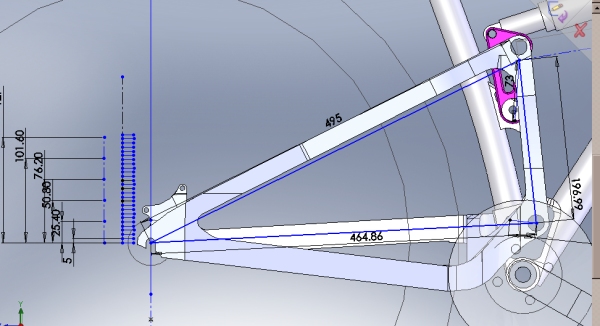
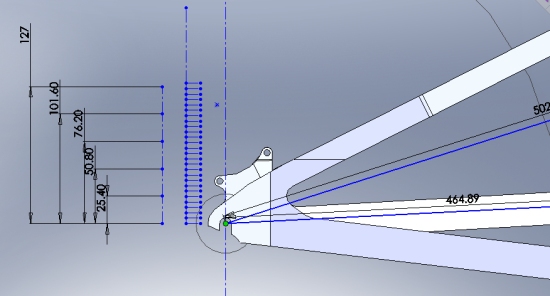
Designed for 29er wheel tire clearance and short chainstays at full travel, my original design was a near vertical axle path. I mean really near vertical. We’re talking a few millimeters. Vertical.

That all adds up to one thing: crazy short chainstays, a characteristic I’m pursuing in a big way on this design, but the trade-off is potential “pedal kickback.”

Depending on which suspension guru you’re talking to, and which side of the bed he or she got out of that morning, pedal kickback is either a nominal concern or the holy-freakin-grail. What is it? Well, there’s this line of torque that drives your bicycle. When you do your mad flailing attempts at pedaling a bike, the energy of your legs rotates the crankset and thus chainring, and at that point, power runs across the top of your chain like a group of magic little elves. It’s that top of the chain–the path that runs from the top of your chainring to the top of your cassette–that’s under tension and is propelling your bike along for you.

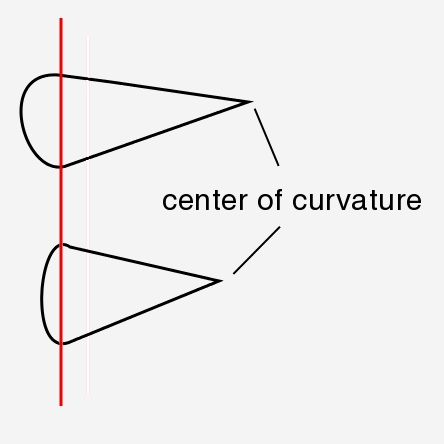
Well, when you add a rear wheel that can go up and down relative to the bottom bracket on your bike, you’ve done some strange things to the length of that line. What exactly you did to it depends on where your bike’s pivot center point is (most of those center points or centers of curvature are “virtual” or move around, though it’s easy to find the center point of a single-pivot bike: it’s just the pivot location). That center of curvature point created by the location of the pivots on a suspension frame determines the shape of your axle path.

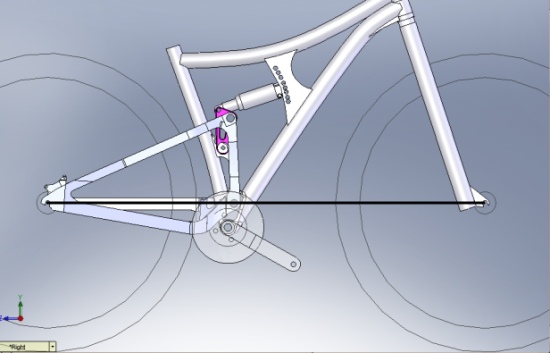
Red line represents pure vertical, but the arcs of actual axle paths are determined by the center of curvature.

So as your rear wheel goes up and down, the magical “power line” connecting your chainring gear and the gear driving your rear wheel tracks along with the arc of your axle path–the one that’s being created by that center of curvature.

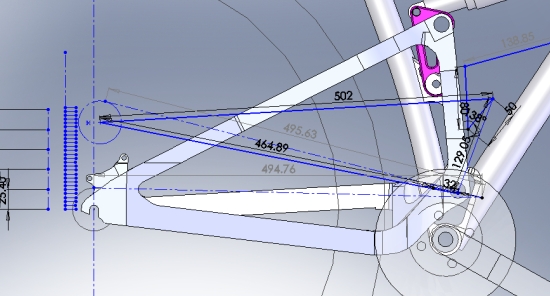
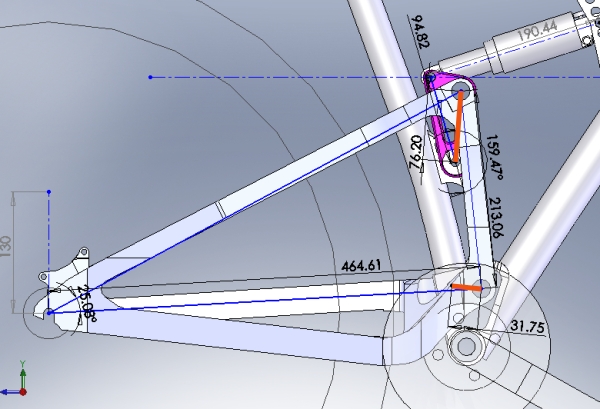
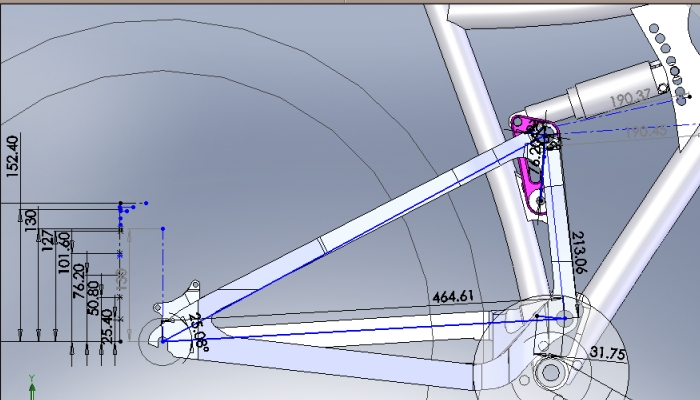
All this just means your chain gets long and shorter as the suspension moves through its travel. How much deviation in chain length you have affects whether or not your bike’s suspension system tugs backward on your chain (which sucks if not moderated effectively) or slackens your chain (which also is no fun). Usually, the point at which your suspension is the most compressed is the problem, as that’s the point at which the distance from your chain’s engagement on your chainring to its engagement point on a given rear cog is the greatests. That hurt my head even to type, so here’s an image. Check out the gray numbers. Those represent the length of the chain when the bike isn’t compressed (494.76mm) and when it’s compressed all the way (495.63mm).

Note the gray numbers: 494.76 (uncompressed) and 495.63 (fully compressed).

In order to get those numbers so close to one another, I had to redesign my frame, and what I traded was approximately 8mm of chainstay length.

So here’s my question to hardcore bike nerds out there: Which is more important, minimizing that chain growth at the end of the bike’s travel, or having really short chainstays?

I’m really only concerned with end of the axle path (full compression). If you have a vertical axle path, your chain grows a good bit (like up to 10mm), but if you arc your axle path inward slightly at the end, you can all but eliminate any chain growth. During the rest of the axle’s path, I’m still going to have very little rearward axle movement. It’ll be there, but it’ll be minimal. So the big question is how far forward to eliminate chain growth do I let the axle roam at the end of the bike’s travel? The further it moves in to maintain consistent chain length, the less clearance between the rear wheel and the frame’s seat tube.

Anyway, that’s what I’m working on right now, instead of sleeping.

Death Cab for Cutie

 Bikes, Swine  Comments Off on Death Cab for Cutie
Nov 212011
 

Earlier today I received an email from CEO and Founder of executive job search site TheLadders.com, Marc Cenedella. While each piece of spam mail I receive from Marc is special to me in its own way, this one was particularly awesome because it featured a video of him in a cab, being authentic at a woman who appears to have been forced into the cab after losing a bet. Here’s the first part of the letter and the video, exactly as I received them, so you can experience a few seconds of my afternoon and marvel for a minute at my exotic, unemployed executive world:

I’m taking my career advice to a new format, folks. I’ve been writing this newsletter to you for the past eight years, and now we’ve decided to take it to the streets!

So I hopped in the back of a New York City taxi and dispensed career advice to professionals like you across the boulevards of southern Manhattan. We’ve filmed the results and I’m pleased to share with you… “CareerCab”!

Here’s the first episode, in which Megan needs help with her elevator pitch:

Like you, my first thought after seeing this was, Rapid cutaways set to spunky rock and roll just always works, but try to fight past being entertained long enough to take in the real wisdom going on here. Megan initially claims to be looking for “a position in healthcare consulting,” and “also looking to work for an academic health center in finance, on the finance side,” but notice how quickly Marc calls her out of such pompous bullshit. By reminding her that they’re in “Career Cab” and then at a backyard barbecue (true business men are adept at disorienting their subjects), Marc instantly disarms Megan, extracting the truth like a valuable incisor. Turns out, she actually wants to work “in finance in healthcare.”

Holy shit.

Check the before and after photos of that transformation, and see if you can notice any similarity whatsoever. Not possible. But hang on, Megan, ’cause clearing those cobwebs was just the beginning. Now Marc’s about to blow your mind. “Why?” he asks. Why do you want to do what you want to do? Did you see that one coming, Megan? Hell no you didn’t, not all tangled in your fancy memorized phrases like “a position in healthcare consulting.”

Clearly rattled now by just how at ease she’s been put, Megan feels around for an explanation, sending words out in “Career Cab” like a bat throws out sonar. “It’s an industry where you help people on Monday,” she says. That’s the stuff. “You don’t, it’s not an intangible–like you go to work and, no matter what, you come home at the end of the day, and you’ve helped a bunch of people. But, so I want to help the doctors be able to do their job better, and I feel like, in finance–operations gets a little hairy, so I think finance is a little, would be a little more hands off, but still facilitate, you know, them being able to care for patients.” While Megan’s soul is slowly being teased right out of her verbal britches, Marc offers increasingly brusque, “Uh huh”s before descending into more urgent “Yeah”s.

Megan’s problems thoroughly diagnosed and solved, Marc stands in awe at her transformation. “Whatever that was you just said,” he tells her, “it was beautiful and it was, like, authentic, and it was really you, and like, nobody else on the planet can say that, because, like, you really believe, like, that’s actually you, and it shines through.”

Now Marc turns the wisdom hose back on me, his unemployed ex-CEO leader, and returns to his letter:

“Somehow, we’ve all tricked ourselves into believing that sounding incomprehensible makes us sound smart. And that’s just simply not true.”

No it’s not, Marc. I hired many people in my time, and anyone who came in spewing shit about motivation and skills never moved me as much as those who told me they mostly liked to sniff glue and watch reruns of “Three’s Company” because they were really passionate about those things. My only critique of Megan is that I’m still not sure she was being completely honest about her passion. Few people are born with a dream to help doctors. If she’d said she wanted the job for the money, so she could go home at night and dream of riding a unicorn to the end of the rainbow where she could hold a leprechaun at gunpoint until he gave her gold, then we’d know Megan was finally being honest with us.

Marc tells me, “When you speak clearly and passionately about what you love, people want to help you more.” Or you are pepper sprayed and arrested. It’s a fine line.

Marc closes (as he often does) with a challenge for me:

So take your story — the story that only you have — and share it with people. It’s the best (and easiest) way to get ahead! I’ll be rooting for you every step of the way,

Marc Cenedella
Marc Cenedella, CEO & Founder

So here goes: I want to revolutionize e-commerce, build the world’s best pedaling bicycle suspension system, and ride a unicorn to the end of a rainbow where I can make a leprechaun give me some gold.

Who’s with me?

Frack!

 Bikes, Swine  Comments Off on Frack!
Nov 182011
 

Just returned from a community meeting. Not normally my idea of a good time on a Friday night, but turns out our humble (and not so humble insanely wealthy) townsfolk have noticed explosive charges and seismic recording equipment suddenly appearing all over the place. More than one company is in town doing 3D seismic testing so they can start drilling for natural gas, a process otherwise known as “fracking,” which has some interesting side effects.

Apparently, that video’s just a misunderstanding, and what they’re doing is entirely safe, despite the fact that nobody seems to know what chemical they’re pumping into the ground. They reassured us tonight that it’s like over 90% water and sand (which is great, because if 90% of my jar of peanut butter doesn’t have salmonella, those are pretty good odds!). I guess I’ll have to go ahead and hope all that sand and water and secret sauce really are safe, because they’ve come in and started drilling before most of us even knew. Once helicoptors started dropping orange bags in your neighbor’s yard and small explosions start going off around town, it’s time to realize you’re getting fracked.

Speaking of which, I’ve hit another wall in my attempt to make a bicycle. The good news is I’ve found a potential builder; the bad news is that I need to rebuild the design in Solidworks before they’d be able to create the bike. I’d really been hoping for more of a partner with the development, but it’s looking like I’ll have to create more of a finished product before I can hand it off to a builder.

I need totally rebuilt.

Unfortunately, this is a problem.

See, I only taught myself enough Solidworks to build the suspension system, and I don’t have a sense of how many more hours it would take me to really dial in details like how to show tubing wall thicknesses, or properly spec internal head tube details, or structurally analyze machined pieces.

Etc.

My goal was to build that suspension system, not to learn Solidworks. I did the same thing when I built web sites for Speedgoat while answering customer phone calls and building bikes back in the day: I learned how to do something in order to accomplish a specific goal. I sucked it up and adapted and accomplished something. Yay for me.

But that’s a stupid way to do things.

One personal criticism of my previous entrepreneurial adventures is that I did too much myself, and here I go again. It feels very wrong–just at it did to be developing pretty complicated data-driven web pages–but once again I’m failing to see the alternative. I’ve invested enough money into the patent process that some more money invested to see a proof-of-concept bike created makes logical sense, but a lot more money doesn’t. And even assuming I had a trust fund to burn through, I seem to have trouble finding people willing to do that little bit extra, even if you’re paying them to do that little bit extra. Part of this is probably my location, as it was in the past, but finding someone to take over a project is impossible. I end up taking my eye off the business because I’m too busy making the product.

It’s really important for me not to be stupid like that again. But I am.

This is going to require some thought. More than anything, I just want to see this frame created so that I can finally see what it can do. Preferably, before my fracking house burns down.

Relating and Shutterstalking

 Bikes  Comments Off on Relating and Shutterstalking
Nov 162011
 

I might’ve taken my particular brand of nerd gonzo a bit far in that last post, but that’s the effect being forced to do excessive amounts of math (that’s with an “a”) tends to do to me. Speaking of nerd gonzo, if you grew up loving bicycles and virtuoso prog rock power trios, Rush drummer, Neil Peart wrote a nice little piece for the Cleveland Plain Dealer about his first century ridding on back roads in Ohio. It’s fluff, but Neil is one of the few people in the world I just go ahead and love unconditionally. Growing up a geek and a drummer, I couldn’t avoid respecting the hell out of a guy who grew up on a farm, clearly practicing paradiddles something like ten hours a day and clearly reading classic literature in every other free moment. That he rode bicycles, too, arrived like a confirmation that my life was on the right track. It wasn’t, but how could I hold that againt him? He’s even reclusive and largely freaked out by people.

He also wrote some books, including one about cycling in West Africa. Respect.

I felt I had some things in common with Neil, but nothing compared to the eerie things I seem to have in common with Internet advertisers. I visited Shutterstock.com once, and decided I wasn’t interested in their services, but now they’re not only following me everywhere I go, but also targeting my interests (hipster triatheletes with bright t-shirts and soul patches).

The truly creepy thing? I hadn’t searched Shutterstock for cycling photos–I was settling a bet about whether or not a certain picture of Jesus was in the public domain, OK? (I have so many hobbies you know nothing about.) Anyway, I’ve been in retail, and I know the companies that offer cookie-tastic ads that chase users around the interwebs, but ones that track me down, figure out I like cycling, and then use that to market to me? Holy shit. That’s as technologically cool as it is personally terrifying.

But it makes sense.

The recipe for real marketing combines one part interest and one part ridiculously asinine bullshit. I like bicycles, for instance, so I’m just a hop, skip, and a jump from buying a brightly colored extremely expensive leather bag that also becomes a saddle cover.

Yes, Brooks has found a way for anyone interested in transporting a single container of Proofide or a small wallet (but not both) to maintain a keen fashion sense. Click through the image to check out the full details. Bonus: there’s a Shutterstock ad wired to appear on that page sometimes, so, chances are, in just visiting the site, you might get a glimpse of something you actually like being used to try to sell you something you don’t. And they say privacy’s dead!

Nov 142011
 

Well, those bastards at Kickstarter failed to approve my perfectly reasonable $12,000,000 wedding project, so it’s back to the dozen or so drawing boards for me. Tough to say if I’m still an entrepreneur or just unemployed at this point, but as long as there’re still more ideas than time to put into them, I’m hoping my membership in the corporate DIY club’s still valid. By some standards, I might be a permanent member. I mean, I sold a company to a billionaire. I didn’t make any money, and clusterfuck doesn’t begin to describe what I walked into, but technically, at least, I think I lived the American Dream there for a second. If it ever happens again, I plan on paying very careful attention to the experience, though, because I still don’t think it’s supposed to feel like inserting a disco ball up your ass while putting your hand in a running garbage disposal.

So one wonders if I’m going to try to launch a new company that sells bikes, and by “one,” I mean “me.” One wonders what the hell I’m going to do next. Always so tough to say with me. What I can tell myself is this: making bicycles–I mean really making bicycles–is tough. I wish I was the type of fucker who could just point to a carbon fiber 29er frame in a wholesale catalog from China or Taiwan, spend a few days deciding on decals (I’m sorry, “graphics”), then put that bitch on my crappy, outsourced web site with a picture of me looking sham-wow successful. There are people doing that right now, and they always seem so happy to be living a life devoid of geometry and javascript. One wonders why I tend to do all of this shit myself. Boy, does one wonder.

But if any of you are still playing along at home, I’m eyeball deep in shock rates right now, and the semi-crushing realization that the orientation of my upper link seems to be limiting my shock position options.
Please ignore the actual shock in the photo. I’ve been locating possible areas all over the place, trying to balance shock rate with a position that doesn’t suck. I absolutely, positively hate bikes with shocks that T-bone the downtube at like a 90-degree angle. You can get away with it (particularly if you’re dealing with titanium or steel), but it’s the design compromise equivalent of throwing up in your mouth. Carpet’s still clean, but that doesn’t mean you don’t have a problem.

So that’s where we are–and I have a possible fabrication shop. We’ll have to see how that goes. If I don’t come to my senses or find myself properly employed by the end of November, I may very well be doing something stupid again. And it bears mentioning that, if I end up starting up another company, it won’t be because I’m a wealthy job creator with low taxes, or because of a government subsidy or grant.

I found two interesting pieces on NPR today. Each was fascinating in its own way, but, taken together, they sort of floored me. The first, was a report from Andrea Seabrook regarding the pervasive undercurrent of Ayn Rand’s “Objectivism” in current political rhetoric. In case you’re still not sure who John Galt is, here’s a quick refresher on Rand: she believed man’s “highest moral purpose is the achievement of his own happiness”, and that those who can do were under constant attack from those who can’t. Into the God-shaped hole, Rand’s philosophy inserted Reason, which sounds pretty great to me. But she didn’t stop there. More frequently on display these days is Rand’s assertion that the ideal world consisted of a tax-free, purely capitalistic economy (as icons go, she specifically replaced the crucifix with a dollar sign), and it’s that part of Objectivism that’s current wailing and knashing its teeth at the injustice of making the wealthy “job creators” pay more taxes or stop buying politicians or stop dumping toxic shit into the environment.

Rand grew up in Russia, and I don’t doubt she believed passionately in her clunky characters and teared up over her own ice cold prose, but in the end, the two-packs a day girl who thought critics of nicotine were perpetrating a hoax found herself taking her government social security payments. The idea of Ayn Rand, though, is something guys like no-tax pledge architect Grover Norquist enjoy dressing up in when all alone and clopping around in front of the mirror to see. Government is bad, and it’s killing the real prime movers of our economy–the Randian heroes, the Roarks, Galts, Taggarts and Reardens–men (generally–gender’s another story entirely in Rand) who use their sweat, their minds, and their hands–modern day embodiments of Atlas, whose inventions and brilliance are doing more than just creating jobs; they’re supporting the world.

You know, guys like Grover Norquist, who, as near as I can tell, have never had an actual job. These are salt of the earth hard workers, born into adversity, like being the son of a Vice President of a large corporation, or having to attend Harvard (on what we can all assume was an academic scholarship, destitute and disenfranchised as the sons of corporate VPs tend to be). Like Galt, Norquist came from “out of nowhere, penniless, parentless, tie-less,” except that he was the opposite of each of those things. Yes, John Galt, humble genius inventor, certainly is eerily visible in today’s Washington hanger-on or billionaire hedge fund manager, or any of the 1%, persecuted by the ignorant masses out of jealousy of their clearly superior intellect and work ethic. Food for thought. Food that’d give you cancer if the Food and Drug Administration weren’t around to stop it, but food nonetheless.

Rand’s resurgent popularity fit nicely with the other interesting thing I overhead today on that liberal hippie-fest, NPR, because who in our modern society compares to a guy able to invent an engine that runs on static electricity? No, not Steve Jobs. Too artsy-fartsy for Rand, to be frank. How about a guy whose invention can turn any water pure?

Dean Kamen, that inventor and entrepreneur who created stuff as diverse as the Segway (not sure we can score that one a win, but bear with me), to high-tech prosthetic arms was being interviewed by John Donvan. Kamen’s theme was America’s current state, and how government emphasis on jobs is missing the point. We’ve lost our drive to innovate, was his point, and we urgently need to address that loss. The interview included this exchange:

DONVAN: The big question in all of this: If you’re correct and we let this happen, why would we let this happen?

KAMEN: I don’t think it was intentional. I think, you know, a rich environment leaves you – you know, people get a little lazy. When you’re a rich country – I think we’ve enjoyed, you know, generation after generation, always doing a little better than their parents. And I think people started to think it’s simply our birthright to have high quality health care and high quality education and…

DONVAN: So – but what did we stop doing? What did – and I’m not sure which we I’m asking about, but let me put it this way: What did we – we just did a show with people about losing work and they want to work. What did we, the workforce, do wrong to contribute to this?

KAMEN: I’m not sure it’s the workforce. I think we as a culture, we as a country lost our edge. We stopped investing in all the leading-edge stuff. The work ethic of your great grandparents and your grandparents – as I said, when you become a culture that seems to be born and you know the water is drinkable and the – you flip the switch and the lights go on and life is good and you have security, maybe you don’t work as hard as they work around the world to pick themselves up out of poverty. But we pick the worst possible time, the worst possible generation to sit back on our laurels because the rest of the world has figured out that the model that worked so well for a few hundred years in the United States, namely highly motivated, highly educated, incentivized innovation – let the government do everything it can to create an atmosphere where entrepreneurs and innovators will risk their life and their resources and their money to create great, new things.

You know, that makes it sound like we have a complicated problem on our hands. Not one that government alone can solve, and–most importantly–not one that our current wealthy seem able to, or interested in, fixing with their god-given superior intellect and work ethic. The “inventions” of our modern American billionaire heroes are credit default swaps not airplanes, housing market bubbles not telephones. “Who is John Galt?” I don’t know, but I’m pretty sure he lives in China now. Grover Norquist picked up his old house in a short sale.

Really Big Announcements

 Bikes, Swine  Comments Off on Really Big Announcements
Nov 112011
 

Reading yesterday’s post from BikeSnobNYC confirmed a suspicion I’ve had about myself for some time now. Unlike NiCole “COLE” Robbins, I actually believe in producing some sort of good or service in order to be paid. And that’s what’s wrong with me.

I believe I’ve fallen out of step with America’s move to a “service economy.” For a while, I understood it. During my early years running my e-commerce business, I answered consumer emails and even picked up some phones at all hours of the day and night. Had I known how much better off my family would be now if instead I’d done crunches all day and focused on being a narcissistic asshole in hopes that MTV would syndicate my “project,” by now I’d have my own line of cologne made specifically for the mentally challenged. Another mistake: my wife and I had a pretty quiet and understated wedding. I realize now that I should have at least called some local news agencies and intimated that the affair involved maintaining the bloodline of Jesus and the real reason Dick Cheney shot that guy in the face. How much do you have to charge per admission to make $18M on a wedding?

To that end, I’m announcing three initiatives today:

First, inspired by NiCole “COLE” Robbins, I launched my own Kickstarter project today. It’s still in the approval stage, but I don’t see any reason why it wouldn’t be permitted, as it seems to violate far fewer policies than NiCole “COLE” Robbins’ project. There may be some slight waffling on the part of the Kickstarter staff regarding the subtle difference between a mere “wiseass artistic statement” versus the more genuine “opportunistic phony cause” that begat it, but that wouldn’t be very cool of them.

What is your project?

I’m looking to raise $12,000,000 to fund a lavish ceremony to remarry my wife (our first wedding was relatively small, and we’d not thought to monetize it). Market research suggests the return on this investment could be $18,000,000 or more, a 50% return on investment, if my math is correct, realized almost immediately. I understand that merely renewing vows may not be sufficiently dramatic, so I’m willing to divorce and remarry this woman, in order to make this work. In supporting me on this exciting journey, you will also be supporting and promoting Love (both the sentiment and the burgeoning new American industry).

What rewards would you offer?

Provided we hit our target goal, relatively high quality digital photos of the wedding, our outstanding children, and our extremely photogenic dog will be provided to all investors. Those contributing more than $500,000 each will also receive an artisanal cupcake–probably one of the really cool “cupcake-pop” style ones that come on a stick. Those are awesome.

Second, I’ll also be launching a new and different web site to track my progress in this endeavor, among other things. Probably.

Oh, and the third thing: maybe I should start a bike company. I mean, I have a strong patent, I know some stuff about bicycles, and I like acting entrepreneurial at parties. I’ve seen people start bike companies with less. So I’m taking votes. Comment or email me. Maybe I could fund it with Kickstarter, now that I’m soon to be a Kickstarter “power user” and return each investor’s total amount as a discount off a frame. That’s starting to sound a little too “old America,” though, where I actually have to make something.

Suspension 101: Get Some?

 Bikes  Comments Off on Suspension 101: Get Some?
Nov 102011
 

Freakishly wonderful weather meant I put some time in on my Jones again today, and I had to chance to ride one of my favorite trails.

I’m aware of the irony of writing about designing a new full-suspension frame while spending time riding a rigid bike, but my trails are so perfectly smooth and obstacle-free that all those fancy pistons and ball bearings and such seem like decadent opulence. Why, once you’re out of the quarter mile rock garden on this section, you have only nine or so logs to hop before things mellow out onto a logging road. (“Logging road” is a local term, referring to rock gardens wide enough to try to drive a quad at least into if not necessarily out of.)

No, in all honestly, I was feeling pretty tired today and had planned on going with the Pivot 429, only to discover it had a flat front tire. I no longer work at a bike shop, which means every time I encounter even a small “mechanical,” I immediately give up and start looking for a different bike. So the Jones 1×10 got the call, and a damn good thing, too. Having rolled up on a 10-point buck entertaining his lady friend, I emerged unscathed and unintimidated, thanks to this.

Only four points, but they're titanium, so step off, Bambi.

While gently coursing along, having the shit only lightly kicked out of me, I had time to contemplate the point of “full-suspension.” A friend following the suspension design stuff I’m working on recently asked me to write more about the basics of suspension–set up, how suspension is supposed to work on a mountain bike, that sort of thing. I’d been wondering where one begins something like that, and suddenly I had my answer.

The first step in understanding the basics of bicycle suspension is to ask yourself if you need it.

I don’t know a single hunter who uses an automatic weapon to bring home the venison. Assault rifles might be able to fire a hell of a lot more bullets at something, but that doesn’t make them “better.” Trying to use one would completely miss the point. But from what I can tell about preferred firearms for violent revolutions and zombie apocalypses, the more bullets, the better. Different strokes, you know. Consider, too, that I was living in Atlanta during the height of the SUV craze, and many of the vehicles being sold there were actually two-wheel-drive. As a guy who had to haul three dogs home to a particularly vertical part of Pennsylvania every winter and planned to move back there soon, I was looking for something a bit more four-wheel-drive, but the salesmen kept acting like I was requesting the humidor custom fitted to fit my favorite cigars option. He didn’t get why I would pay extra for powered front wheels. (In the end, we could only afford the powered front wheels of a comically small Saturn anyway.)

So my first piece of advice about owning a mountain bike with suspension is to ask yourself if you want it. Even the best full-suspension frames out there are more complicated than a rigid bike, and ask more of their owners. Maybe your trails are perfectly smooth (like mine), and you accidentally started a fire the last time you tried to change a lightbulb–in which case, the more enjoyable long term decision might be a bike with less going on.

There certainly seems to be a lot of simplicity going on these days. If you just dabble in the whole “mountain biking” thing, no doubt you’ve noticed that a lot of the cool guys have switched to brightly colored, really simple bikes and micro-brews with more complicated label graphics, instead of the previous vice versa.

This is because everyone else found out about full-suspension bikes, and owning one no longer says, “I’m deadly serious about this shit,” the way it used to.

"You aren't stupid passionate like I'm stupid passionate" circa 1999.

They were riding full-suspension bikes when you were roller-blading, pal. Green Day isn’t a punk band. Welders’ hats are the new trucker hats. Marilyn Manson was just Skinny Puppy for slow kids. Handlebar mustaches are the new sideburns. Etc.

So maybe you don’t need a full-suspension frame for your riding, and you can get much nicer components for less money on a bike without suspension. With less to fiddle with, you might even ride more. It could be awesome.

But probably not.

For a lot of trails that aren’t as smooth and boring as mine, even a pretty compliant steel, titanium, or carbon frame that doesn’t have wheels that go up and down when they hit something is going to kick the living shit out of you every once in a while. Most owners of ultra-minimalist single-speeds also own suspension bikes, and the trade-off of lugging around the added weight and complexity sometimes means being able to walk the next day. It’s good to understand that–particularly with the rise of very slightly smoother-rolling 29ers–full-suspension bikes are no longer quite as aspirational–a marketing term that means “shit you want without knowing why,” but they still make a hell of a lot of sense.

So the first step to buying a full-suspension bike isn’t a technical detail or consumer check list: it’s asking yourself if you need one. You’re the expert there, and your favorite trails are your resource. They’ll tell you what type of bike to own, and whether you need a Jones H-bar, or an automatic weapon.

The Details

 Bikes  Comments Off on The Details
Nov 082011
 

I’m sure there’s confusing and intentionally misleading information about playing the stock market or home dentistry here on the Internet, but I have a hard time believing any information out there is as screwed up as what I see about shock rates on mountain bikes. What we hear from a lot of manufacturers comes to us as filtered through the Marketing department, and for all we know originated as much in Accounting as in Engineering (“Say, we got a great deal on a thousand rockers so-and-so couldn’t use. How ’bout you design a frame that uses them?”), so bullshit is rampant. Often, getting information about how suspension systems actually work in this business is like listening to a drunk friend describe a movie you’ve never seen.

I’m certainly no engineering expert myself, though as English Majors go, I think I’m passable, and I do have that level of respect for simple machines that gets earned somewhere in the four thousandth hour of staring at a design and trying to figure out why it keeps laughing and kicking you in the nuts instead of “working.” The key to making something decent is knowing what you want, and what I want out of my design is the Holy Grail of shock rates: the highly variable one.

In an earlier post, I’d mentioned the advantages of using short rockers to give yourself maximum shock rate tuning options. My thinking there–and it could be flawed, but I don’t think so–is that shorter rockers have the ability to rotate more throughout the movement of a suspension system (as opposed to something like a Horst-link bike, in which the whole chainstay is effectively a slower rotating link), and that two substantially rotating little rockers open a lot of tuning doors.

Why? In the illustration below, I’ve colored my rockers orange.

Consider the rotation of each of the orange rockers in the image above. Now imagine each of those orange lines connected to the main frame and spinning in a circle, what you effectively have are two gears. Their movement can be very finely tuned, and that means so can your shock rate.

So now’s the time in the course of development when I throw out all previous shock rates I’d created and look to come up with one, final, “perfect” set of shock and leverage rates I can graph like these examples. Ideally, you want your suspension to be as supple as possible up to the sag point–the point to which the suspension should compress with a rider on the bike–then firm up at and just past that point for pedaling, then drop away some for smooth bump absorption during that middle range of travel, before finally firming up again as the frame begins to run out of travel.

That might seem like total gobbledygook to some of you, but hardcore nerds out there, I welcome your feedback: please send your thoughts as to the ultimate shock rates throughout a bicycle’s rear wheel travel. I’ll keep tuning that shock position and those rates in the meantime, and will try to go into greater detail right here. There’s still a particular type of ride that I’ve just never gotten from any other frame, and that’s what I’m after.

That, and a name for this thing. Suggestions welcome there, too.

Made in the U.S.A.?

 Bikes  Comments Off on Made in the U.S.A.?
Nov 072011
 

One of the criticisms I often hear of high-end bike companies is that all of their frames are made in Taiwan (or, increasingly, China). The assumption here is that production costs in developing countries are so low that brands are outsourcing to drive up their profits and make more money–and that’s usually a pretty good assumption. But as a guy trying to get a prototype frame built, so far it’s been my impression that Taiwan is not the cheapest, but rather the only place to do it.

I hope I’ll be proven wrong, but so far companies in Taiwan, and their trading agents, have proven to be drastically more responsive and interested in building the frame. Stateside builders I’ve talked with either lack resources and need a year or more to get something built, or don’t seem interested in getting back to me. And that sucks. I’d rather build this prototype here. In an ideal world, I’d even like to have options in a fabricator, and get this single frame built in six months.

But what’s become pretty obvious to me is that there’s just not much small-scale manufacturing going on here. That isn’t to say we can’t make things. In a backyard DIY sort of way, we’re still the top of the food chain. We still have enough of a middle class that once upon a time had disposable income for some of us to have small machine shops and painting booths in our garages, and we know how to genuinely create something. But we seem to go straight from “I have a friend who can MIG weld” to “Alcoa,” without all that much in between.

No, we’re more of a “Service Economy,” which means we better hope they keep opening new Starbucks.

At least BikeRumour was showing off some serious hardware that’s U.S. made.

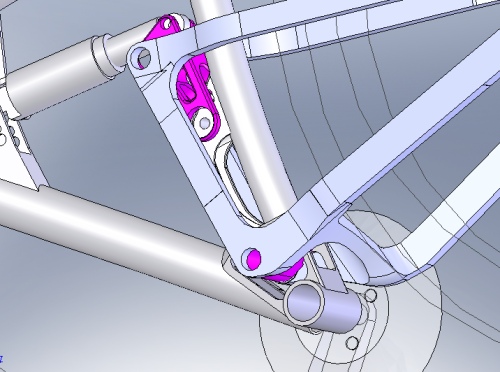
Speaking of the prototype I’ve looking to create, most of the questions I’ve been getting revolve around (pun intended) the lower rocker. Here’s a detail shot:

One of the patented aspects of the design is the position of that lower rocker. Unlike a lot of short lower rocker orientations, this design lets the swingarm attach at the front of the rocker–ahead of where the rocker attaches to the frame. This allows for several things I believe to be very good, but one key characteristic of the design is a 29’er-friendly axle path.

Most people can understand that the larger diameter rear wheel causes clearance issues with the frame–in particular, once a bump force acts on the suspension and moves the rear wheel upward, it doesn’t take long for that arcing big wheel to get really close to the bike’s seat tube. That part’s pretty straightforward. But a 29er’s bottom bracket also sits lower relative to a bike with 26″ wheels. Because of that lower bottom bracket (aka “increased bottom bracket drop”), a totally unladen 29er is a little like a 26″ wheeled bike that’s already partway into its rear travel.

Center of the bottom bracket sits significantly below the axle.

This all means that axle path relative to that bottom bracket shell is critical on a 29er. (In the process of working this out, I looked at Niner’s CVA system, which is a pretty brilliant way to deal with the challenges of the added bottom bracket drop on a 29er.) Getting sufficient travel without having to shove the seat tube forward (shortening the effective length of the rider’s compartment) or pushing wheel out behind the rider with longer chainstays (which can decrease maneuverability and make the bike ride “flat footed”), is a challenge.

After a whole lot of hours testing rocker widths, angles, and orientations, I believe I’ve found an axle path that will let a 29er be as agile as most 26″ wheeled bikes. There was also a very specific effect I wanted to see happen with the swingarm, and I’ll have some more on that later.