This is clearly the hot shit setup. Check out these photos.
Mountain Biking Photos Captured with a Chest-Mounted DSLR – http://pulse.me/s/3fMVy

This is clearly the hot shit setup. Check out these photos.
Mountain Biking Photos Captured with a Chest-Mounted DSLR – http://pulse.me/s/3fMVy
I might’ve taken my particular brand of nerd gonzo a bit far in that last post, but that’s the effect being forced to do excessive amounts of math (that’s with an “a”) tends to do to me. Speaking of nerd gonzo, if you grew up loving bicycles and virtuoso prog rock power trios, Rush drummer, Neil Peart wrote a nice little piece for the Cleveland Plain Dealer about his first century ridding on back roads in Ohio. It’s fluff, but Neil is one of the few people in the world I just go ahead and love unconditionally. Growing up a geek and a drummer, I couldn’t avoid respecting the hell out of a guy who grew up on a farm, clearly practicing paradiddles something like ten hours a day and clearly reading classic literature in every other free moment. That he rode bicycles, too, arrived like a confirmation that my life was on the right track. It wasn’t, but how could I hold that againt him? He’s even reclusive and largely freaked out by people.
He also wrote some books, including one about cycling in West Africa. Respect.
I felt I had some things in common with Neil, but nothing compared to the eerie things I seem to have in common with Internet advertisers. I visited Shutterstock.com once, and decided I wasn’t interested in their services, but now they’re not only following me everywhere I go, but also targeting my interests (hipster triatheletes with bright t-shirts and soul patches).

The truly creepy thing? I hadn’t searched Shutterstock for cycling photos–I was settling a bet about whether or not a certain picture of Jesus was in the public domain, OK? (I have so many hobbies you know nothing about.) Anyway, I’ve been in retail, and I know the companies that offer cookie-tastic ads that chase users around the interwebs, but ones that track me down, figure out I like cycling, and then use that to market to me? Holy shit. That’s as technologically cool as it is personally terrifying.
But it makes sense.
The recipe for real marketing combines one part interest and one part ridiculously asinine bullshit. I like bicycles, for instance, so I’m just a hop, skip, and a jump from buying a brightly colored extremely expensive leather bag that also becomes a saddle cover.

Yes, Brooks has found a way for anyone interested in transporting a single container of Proofide or a small wallet (but not both) to maintain a keen fashion sense. Click through the image to check out the full details. Bonus: there’s a Shutterstock ad wired to appear on that page sometimes, so, chances are, in just visiting the site, you might get a glimpse of something you actually like being used to try to sell you something you don’t. And they say privacy’s dead!
Well, those bastards at Kickstarter failed to approve my perfectly reasonable $12,000,000 wedding project, so it’s back to the dozen or so drawing boards for me. Tough to say if I’m still an entrepreneur or just unemployed at this point, but as long as there’re still more ideas than time to put into them, I’m hoping my membership in the corporate DIY club’s still valid. By some standards, I might be a permanent member. I mean, I sold a company to a billionaire. I didn’t make any money, and clusterfuck doesn’t begin to describe what I walked into, but technically, at least, I think I lived the American Dream there for a second. If it ever happens again, I plan on paying very careful attention to the experience, though, because I still don’t think it’s supposed to feel like inserting a disco ball up your ass while putting your hand in a running garbage disposal.
So one wonders if I’m going to try to launch a new company that sells bikes, and by “one,” I mean “me.” One wonders what the hell I’m going to do next. Always so tough to say with me. What I can tell myself is this: making bicycles–I mean really making bicycles–is tough. I wish I was the type of fucker who could just point to a carbon fiber 29er frame in a wholesale catalog from China or Taiwan, spend a few days deciding on decals (I’m sorry, “graphics”), then put that bitch on my crappy, outsourced web site with a picture of me looking sham-wow successful. There are people doing that right now, and they always seem so happy to be living a life devoid of geometry and javascript. One wonders why I tend to do all of this shit myself. Boy, does one wonder.
But if any of you are still playing along at home, I’m eyeball deep in shock rates right now, and the semi-crushing realization that the orientation of my upper link seems to be limiting my shock position options.
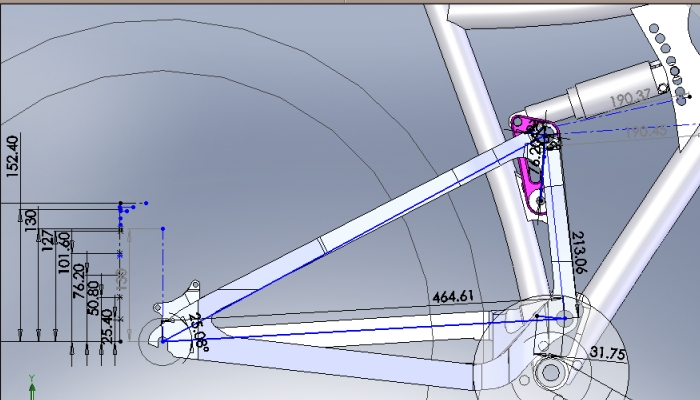
Please ignore the actual shock in the photo. I’ve been locating possible areas all over the place, trying to balance shock rate with a position that doesn’t suck. I absolutely, positively hate bikes with shocks that T-bone the downtube at like a 90-degree angle. You can get away with it (particularly if you’re dealing with titanium or steel), but it’s the design compromise equivalent of throwing up in your mouth. Carpet’s still clean, but that doesn’t mean you don’t have a problem.
So that’s where we are–and I have a possible fabrication shop. We’ll have to see how that goes. If I don’t come to my senses or find myself properly employed by the end of November, I may very well be doing something stupid again. And it bears mentioning that, if I end up starting up another company, it won’t be because I’m a wealthy job creator with low taxes, or because of a government subsidy or grant.
I found two interesting pieces on NPR today. Each was fascinating in its own way, but, taken together, they sort of floored me. The first, was a report from Andrea Seabrook regarding the pervasive undercurrent of Ayn Rand’s “Objectivism” in current political rhetoric. In case you’re still not sure who John Galt is, here’s a quick refresher on Rand: she believed man’s “highest moral purpose is the achievement of his own happiness”, and that those who can do were under constant attack from those who can’t. Into the God-shaped hole, Rand’s philosophy inserted Reason, which sounds pretty great to me. But she didn’t stop there. More frequently on display these days is Rand’s assertion that the ideal world consisted of a tax-free, purely capitalistic economy (as icons go, she specifically replaced the crucifix with a dollar sign), and it’s that part of Objectivism that’s current wailing and knashing its teeth at the injustice of making the wealthy “job creators” pay more taxes or stop buying politicians or stop dumping toxic shit into the environment.
Rand grew up in Russia, and I don’t doubt she believed passionately in her clunky characters and teared up over her own ice cold prose, but in the end, the two-packs a day girl who thought critics of nicotine were perpetrating a hoax found herself taking her government social security payments. The idea of Ayn Rand, though, is something guys like no-tax pledge architect Grover Norquist enjoy dressing up in when all alone and clopping around in front of the mirror to see. Government is bad, and it’s killing the real prime movers of our economy–the Randian heroes, the Roarks, Galts, Taggarts and Reardens–men (generally–gender’s another story entirely in Rand) who use their sweat, their minds, and their hands–modern day embodiments of Atlas, whose inventions and brilliance are doing more than just creating jobs; they’re supporting the world.
You know, guys like Grover Norquist, who, as near as I can tell, have never had an actual job. These are salt of the earth hard workers, born into adversity, like being the son of a Vice President of a large corporation, or having to attend Harvard (on what we can all assume was an academic scholarship, destitute and disenfranchised as the sons of corporate VPs tend to be). Like Galt, Norquist came from “out of nowhere, penniless, parentless, tie-less,” except that he was the opposite of each of those things. Yes, John Galt, humble genius inventor, certainly is eerily visible in today’s Washington hanger-on or billionaire hedge fund manager, or any of the 1%, persecuted by the ignorant masses out of jealousy of their clearly superior intellect and work ethic. Food for thought. Food that’d give you cancer if the Food and Drug Administration weren’t around to stop it, but food nonetheless.
Rand’s resurgent popularity fit nicely with the other interesting thing I overhead today on that liberal hippie-fest, NPR, because who in our modern society compares to a guy able to invent an engine that runs on static electricity? No, not Steve Jobs. Too artsy-fartsy for Rand, to be frank. How about a guy whose invention can turn any water pure?
Dean Kamen, that inventor and entrepreneur who created stuff as diverse as the Segway (not sure we can score that one a win, but bear with me), to high-tech prosthetic arms was being interviewed by John Donvan. Kamen’s theme was America’s current state, and how government emphasis on jobs is missing the point. We’ve lost our drive to innovate, was his point, and we urgently need to address that loss. The interview included this exchange:
KAMEN: I don’t think it was intentional. I think, you know, a rich environment leaves you – you know, people get a little lazy. When you’re a rich country – I think we’ve enjoyed, you know, generation after generation, always doing a little better than their parents. And I think people started to think it’s simply our birthright to have high quality health care and high quality education and…
DONVAN: So – but what did we stop doing? What did – and I’m not sure which we I’m asking about, but let me put it this way: What did we – we just did a show with people about losing work and they want to work. What did we, the workforce, do wrong to contribute to this?
KAMEN: I’m not sure it’s the workforce. I think we as a culture, we as a country lost our edge. We stopped investing in all the leading-edge stuff. The work ethic of your great grandparents and your grandparents – as I said, when you become a culture that seems to be born and you know the water is drinkable and the – you flip the switch and the lights go on and life is good and you have security, maybe you don’t work as hard as they work around the world to pick themselves up out of poverty. But we pick the worst possible time, the worst possible generation to sit back on our laurels because the rest of the world has figured out that the model that worked so well for a few hundred years in the United States, namely highly motivated, highly educated, incentivized innovation – let the government do everything it can to create an atmosphere where entrepreneurs and innovators will risk their life and their resources and their money to create great, new things.
You know, that makes it sound like we have a complicated problem on our hands. Not one that government alone can solve, and–most importantly–not one that our current wealthy seem able to, or interested in, fixing with their god-given superior intellect and work ethic. The “inventions” of our modern American billionaire heroes are credit default swaps not airplanes, housing market bubbles not telephones. “Who is John Galt?” I don’t know, but I’m pretty sure he lives in China now. Grover Norquist picked up his old house in a short sale.
Reading yesterday’s post from BikeSnobNYC confirmed a suspicion I’ve had about myself for some time now. Unlike NiCole “COLE” Robbins, I actually believe in producing some sort of good or service in order to be paid. And that’s what’s wrong with me.
I believe I’ve fallen out of step with America’s move to a “service economy.” For a while, I understood it. During my early years running my e-commerce business, I answered consumer emails and even picked up some phones at all hours of the day and night. Had I known how much better off my family would be now if instead I’d done crunches all day and focused on being a narcissistic asshole in hopes that MTV would syndicate my “project,” by now I’d have my own line of cologne made specifically for the mentally challenged. Another mistake: my wife and I had a pretty quiet and understated wedding. I realize now that I should have at least called some local news agencies and intimated that the affair involved maintaining the bloodline of Jesus and the real reason Dick Cheney shot that guy in the face. How much do you have to charge per admission to make $18M on a wedding?
To that end, I’m announcing three initiatives today:
First, inspired by NiCole “COLE” Robbins, I launched my own Kickstarter project today. It’s still in the approval stage, but I don’t see any reason why it wouldn’t be permitted, as it seems to violate far fewer policies than NiCole “COLE” Robbins’ project. There may be some slight waffling on the part of the Kickstarter staff regarding the subtle difference between a mere “wiseass artistic statement” versus the more genuine “opportunistic phony cause” that begat it, but that wouldn’t be very cool of them.
Second, I’ll also be launching a new and different web site to track my progress in this endeavor, among other things. Probably.
Oh, and the third thing: maybe I should start a bike company. I mean, I have a strong patent, I know some stuff about bicycles, and I like acting entrepreneurial at parties. I’ve seen people start bike companies with less. So I’m taking votes. Comment or email me. Maybe I could fund it with Kickstarter, now that I’m soon to be a Kickstarter “power user” and return each investor’s total amount as a discount off a frame. That’s starting to sound a little too “old America,” though, where I actually have to make something.
Freakishly wonderful weather meant I put some time in on my Jones again today, and I had to chance to ride one of my favorite trails.
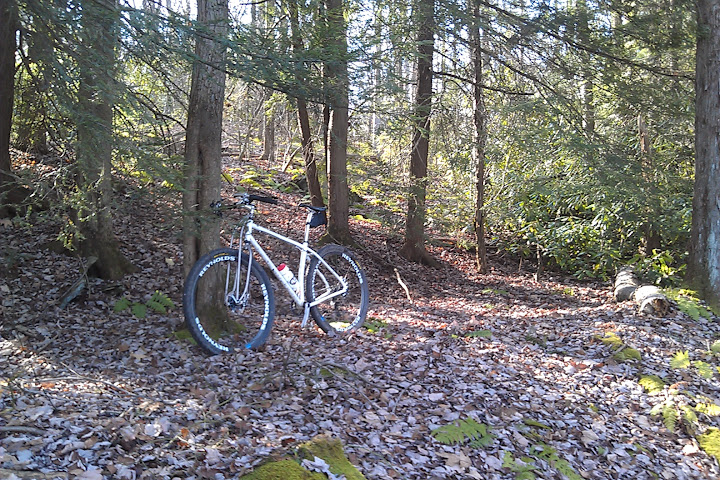
I’m aware of the irony of writing about designing a new full-suspension frame while spending time riding a rigid bike, but my trails are so perfectly smooth and obstacle-free that all those fancy pistons and ball bearings and such seem like decadent opulence. Why, once you’re out of the quarter mile rock garden on this section, you have only nine or so logs to hop before things mellow out onto a logging road. (“Logging road” is a local term, referring to rock gardens wide enough to try to drive a quad at least into if not necessarily out of.)
No, in all honestly, I was feeling pretty tired today and had planned on going with the Pivot 429, only to discover it had a flat front tire. I no longer work at a bike shop, which means every time I encounter even a small “mechanical,” I immediately give up and start looking for a different bike. So the Jones 1×10 got the call, and a damn good thing, too. Having rolled up on a 10-point buck entertaining his lady friend, I emerged unscathed and unintimidated, thanks to this.

Only four points, but they're titanium, so step off, Bambi.
While gently coursing along, having the shit only lightly kicked out of me, I had time to contemplate the point of “full-suspension.” A friend following the suspension design stuff I’m working on recently asked me to write more about the basics of suspension–set up, how suspension is supposed to work on a mountain bike, that sort of thing. I’d been wondering where one begins something like that, and suddenly I had my answer.
The first step in understanding the basics of bicycle suspension is to ask yourself if you need it.
I don’t know a single hunter who uses an automatic weapon to bring home the venison. Assault rifles might be able to fire a hell of a lot more bullets at something, but that doesn’t make them “better.” Trying to use one would completely miss the point. But from what I can tell about preferred firearms for violent revolutions and zombie apocalypses, the more bullets, the better. Different strokes, you know. Consider, too, that I was living in Atlanta during the height of the SUV craze, and many of the vehicles being sold there were actually two-wheel-drive. As a guy who had to haul three dogs home to a particularly vertical part of Pennsylvania every winter and planned to move back there soon, I was looking for something a bit more four-wheel-drive, but the salesmen kept acting like I was requesting the humidor custom fitted to fit my favorite cigars option. He didn’t get why I would pay extra for powered front wheels. (In the end, we could only afford the powered front wheels of a comically small Saturn anyway.)
So my first piece of advice about owning a mountain bike with suspension is to ask yourself if you want it. Even the best full-suspension frames out there are more complicated than a rigid bike, and ask more of their owners. Maybe your trails are perfectly smooth (like mine), and you accidentally started a fire the last time you tried to change a lightbulb–in which case, the more enjoyable long term decision might be a bike with less going on.
There certainly seems to be a lot of simplicity going on these days. If you just dabble in the whole “mountain biking” thing, no doubt you’ve noticed that a lot of the cool guys have switched to brightly colored, really simple bikes and micro-brews with more complicated label graphics, instead of the previous vice versa.
This is because everyone else found out about full-suspension bikes, and owning one no longer says, “I’m deadly serious about this shit,” the way it used to.
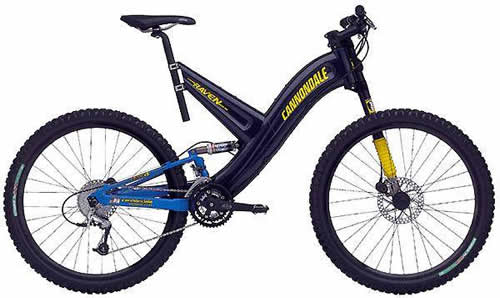
"You aren't stupid passionate like I'm stupid passionate" circa 1999.
They were riding full-suspension bikes when you were roller-blading, pal. Green Day isn’t a punk band. Welders’ hats are the new trucker hats. Marilyn Manson was just Skinny Puppy for slow kids. Handlebar mustaches are the new sideburns. Etc.
So maybe you don’t need a full-suspension frame for your riding, and you can get much nicer components for less money on a bike without suspension. With less to fiddle with, you might even ride more. It could be awesome.
But probably not.
For a lot of trails that aren’t as smooth and boring as mine, even a pretty compliant steel, titanium, or carbon frame that doesn’t have wheels that go up and down when they hit something is going to kick the living shit out of you every once in a while. Most owners of ultra-minimalist single-speeds also own suspension bikes, and the trade-off of lugging around the added weight and complexity sometimes means being able to walk the next day. It’s good to understand that–particularly with the rise of very slightly smoother-rolling 29ers–full-suspension bikes are no longer quite as aspirational–a marketing term that means “shit you want without knowing why,” but they still make a hell of a lot of sense.
So the first step to buying a full-suspension bike isn’t a technical detail or consumer check list: it’s asking yourself if you need one. You’re the expert there, and your favorite trails are your resource. They’ll tell you what type of bike to own, and whether you need a Jones H-bar, or an automatic weapon.
I’m sure there’s confusing and intentionally misleading information about playing the stock market or home dentistry here on the Internet, but I have a hard time believing any information out there is as screwed up as what I see about shock rates on mountain bikes. What we hear from a lot of manufacturers comes to us as filtered through the Marketing department, and for all we know originated as much in Accounting as in Engineering (“Say, we got a great deal on a thousand rockers so-and-so couldn’t use. How ’bout you design a frame that uses them?”), so bullshit is rampant. Often, getting information about how suspension systems actually work in this business is like listening to a drunk friend describe a movie you’ve never seen.
I’m certainly no engineering expert myself, though as English Majors go, I think I’m passable, and I do have that level of respect for simple machines that gets earned somewhere in the four thousandth hour of staring at a design and trying to figure out why it keeps laughing and kicking you in the nuts instead of “working.” The key to making something decent is knowing what you want, and what I want out of my design is the Holy Grail of shock rates: the highly variable one.
In an earlier post, I’d mentioned the advantages of using short rockers to give yourself maximum shock rate tuning options. My thinking there–and it could be flawed, but I don’t think so–is that shorter rockers have the ability to rotate more throughout the movement of a suspension system (as opposed to something like a Horst-link bike, in which the whole chainstay is effectively a slower rotating link), and that two substantially rotating little rockers open a lot of tuning doors.
Why? In the illustration below, I’ve colored my rockers orange.
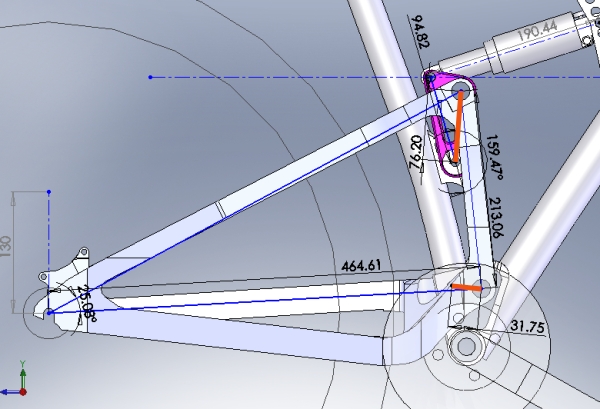
Consider the rotation of each of the orange rockers in the image above. Now imagine each of those orange lines connected to the main frame and spinning in a circle, what you effectively have are two gears. Their movement can be very finely tuned, and that means so can your shock rate.
So now’s the time in the course of development when I throw out all previous shock rates I’d created and look to come up with one, final, “perfect” set of shock and leverage rates I can graph like these examples. Ideally, you want your suspension to be as supple as possible up to the sag point–the point to which the suspension should compress with a rider on the bike–then firm up at and just past that point for pedaling, then drop away some for smooth bump absorption during that middle range of travel, before finally firming up again as the frame begins to run out of travel.
That might seem like total gobbledygook to some of you, but hardcore nerds out there, I welcome your feedback: please send your thoughts as to the ultimate shock rates throughout a bicycle’s rear wheel travel. I’ll keep tuning that shock position and those rates in the meantime, and will try to go into greater detail right here. There’s still a particular type of ride that I’ve just never gotten from any other frame, and that’s what I’m after.
That, and a name for this thing. Suggestions welcome there, too.
One of the criticisms I often hear of high-end bike companies is that all of their frames are made in Taiwan (or, increasingly, China). The assumption here is that production costs in developing countries are so low that brands are outsourcing to drive up their profits and make more money–and that’s usually a pretty good assumption. But as a guy trying to get a prototype frame built, so far it’s been my impression that Taiwan is not the cheapest, but rather the only place to do it.
I hope I’ll be proven wrong, but so far companies in Taiwan, and their trading agents, have proven to be drastically more responsive and interested in building the frame. Stateside builders I’ve talked with either lack resources and need a year or more to get something built, or don’t seem interested in getting back to me. And that sucks. I’d rather build this prototype here. In an ideal world, I’d even like to have options in a fabricator, and get this single frame built in six months.
But what’s become pretty obvious to me is that there’s just not much small-scale manufacturing going on here. That isn’t to say we can’t make things. In a backyard DIY sort of way, we’re still the top of the food chain. We still have enough of a middle class that once upon a time had disposable income for some of us to have small machine shops and painting booths in our garages, and we know how to genuinely create something. But we seem to go straight from “I have a friend who can MIG weld” to “Alcoa,” without all that much in between.
No, we’re more of a “Service Economy,” which means we better hope they keep opening new Starbucks.
At least BikeRumour was showing off some serious hardware that’s U.S. made.
Speaking of the prototype I’ve looking to create, most of the questions I’ve been getting revolve around (pun intended) the lower rocker. Here’s a detail shot:
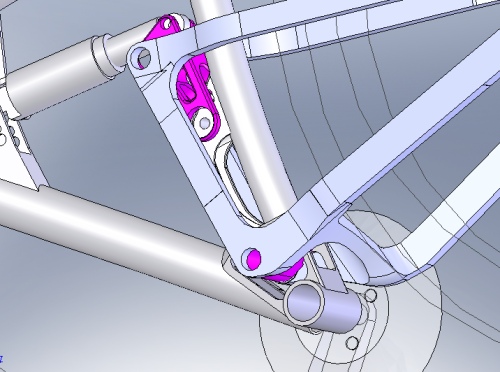
One of the patented aspects of the design is the position of that lower rocker. Unlike a lot of short lower rocker orientations, this design lets the swingarm attach at the front of the rocker–ahead of where the rocker attaches to the frame. This allows for several things I believe to be very good, but one key characteristic of the design is a 29’er-friendly axle path.
Most people can understand that the larger diameter rear wheel causes clearance issues with the frame–in particular, once a bump force acts on the suspension and moves the rear wheel upward, it doesn’t take long for that arcing big wheel to get really close to the bike’s seat tube. That part’s pretty straightforward. But a 29er’s bottom bracket also sits lower relative to a bike with 26″ wheels. Because of that lower bottom bracket (aka “increased bottom bracket drop”), a totally unladen 29er is a little like a 26″ wheeled bike that’s already partway into its rear travel.
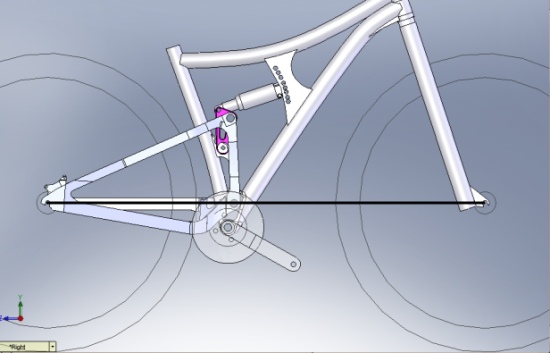
Center of the bottom bracket sits significantly below the axle.
This all means that axle path relative to that bottom bracket shell is critical on a 29er. (In the process of working this out, I looked at Niner’s CVA system, which is a pretty brilliant way to deal with the challenges of the added bottom bracket drop on a 29er.) Getting sufficient travel without having to shove the seat tube forward (shortening the effective length of the rider’s compartment) or pushing wheel out behind the rider with longer chainstays (which can decrease maneuverability and make the bike ride “flat footed”), is a challenge.
After a whole lot of hours testing rocker widths, angles, and orientations, I believe I’ve found an axle path that will let a 29er be as agile as most 26″ wheeled bikes. There was also a very specific effect I wanted to see happen with the swingarm, and I’ll have some more on that later.
Nigel Tufnel Day is fast approaching, and that means spending quality time with the family, singing along to “War Pigs,” and trying to explain a Maiden show to the kids.
I’m not sure what it says about me that I let my six-year-olds watch GWAR on Jimmy Fallon (don’t worry, I DVR’d it–I’m a stickler for bed times), but I’m pretty sure that when you tell them you once almost managed to rip the giant rubber hammer Oderus was using to bash members of the audience on the head right out of his claws, you’re not supposed to beam with crazy pride when one of the kids looks up at you and says, “I want my life to be just like yours.” (If there hadn’t been so much fake blood, I’d’ve had that hammer, too.)

Balsac is the intellectual one.
At any rate, the ultimate “going to 11” day is nearly upon us, and it has me all philosophical and pondering the current place of the not-so-heaviest of metals in the world of bicycles: aluminum. (“Aluminium” for those of you who feel the need to add still more vowels to perfectly good words.) As a guy thinking more and more about designing a bicycle, what I’m wondering is, will there be any high-end aluminum bike frames ten years from now? Five?
Don’t get me wrong: steel isn’t going anywhere, and if Moots were a publicly traded stock, I’d be in that, but one has to wonder whether carbon fiber is slowly becoming the only game in town for fancy-pants, high-tech frames. When it comes for ultimate frame materials–particularly for full-suspension frame–there’s just none more black than carbon fiber.
So what would you do?
This isn’t a bridge I have to cross right away, and I don’t think I’ve ever known anyone crazy enough to use carbon fiber for prototypes (well, OK, there was at least one), but, if you wanted to try to impress the world with what you suspect might just be a decently badass suspension design, would you produce the frames from aluminum, or is the bar so high these days that you have to go straight to carbon to even be competitive?
That’s what I’m wondering tonight.
That, and, “Why don’t more vocalists use analog profanity editing techniques during live performances like Maynard?”
(*Made in Taiwan?)
Just when I think I’m down to only snarky rants, something important to me and maybe even interesting to others comes along. In this case, my search for someone to build me a frame has become the sort of thing worth mentioning here, because it’s decision time.
I’ve been hoping to find someone capable of fabricating a frame for me. Before anyone suggests I go to Portland, where custom frame builders cluster around the pedi-cabs of tourists, jostling for attention and occasionally locking handlebar mustaches in terrifying displays of territorial competition, I’m not looking for an “artisinal” frame builder capable of airbrushing The Last Supper on a steel hardtail with six top tubes (though that would be pretty cool). I’m looking for more of machine shop this time around. This is the contraption what I’m fixing to see made:
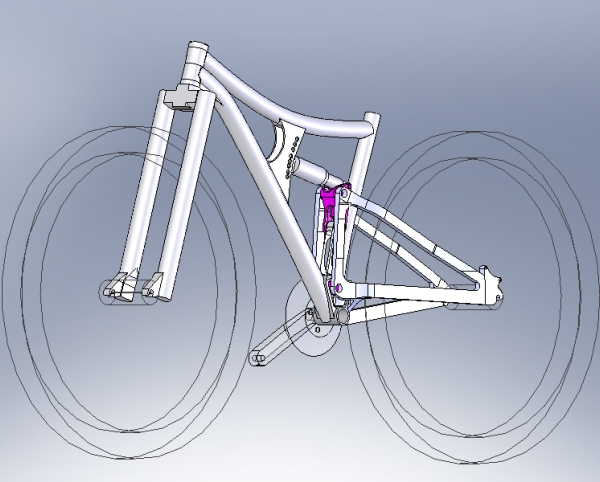
In 2007 I came up with a different take on a suspension system for a bike frame, then forgot about it until the patent was approved last year. I’m a fan of crowdsourcing ideas, and previously mentioned that I’m open to any ideas for the design and for partnerships, but, unless you’ve read the patent in detail, chances are you don’t know much about the design. I’m going to try to provide as many details about the design as possible here at canootervalve.com, and, as always, I’m easy to find at chris@canootervalve.com and would love to talk suspension systems.
Here’s some things I’m up to with the design:
Here’s a quick animated GIF to help illustrate the motion of the swingarm, which is the unique part.
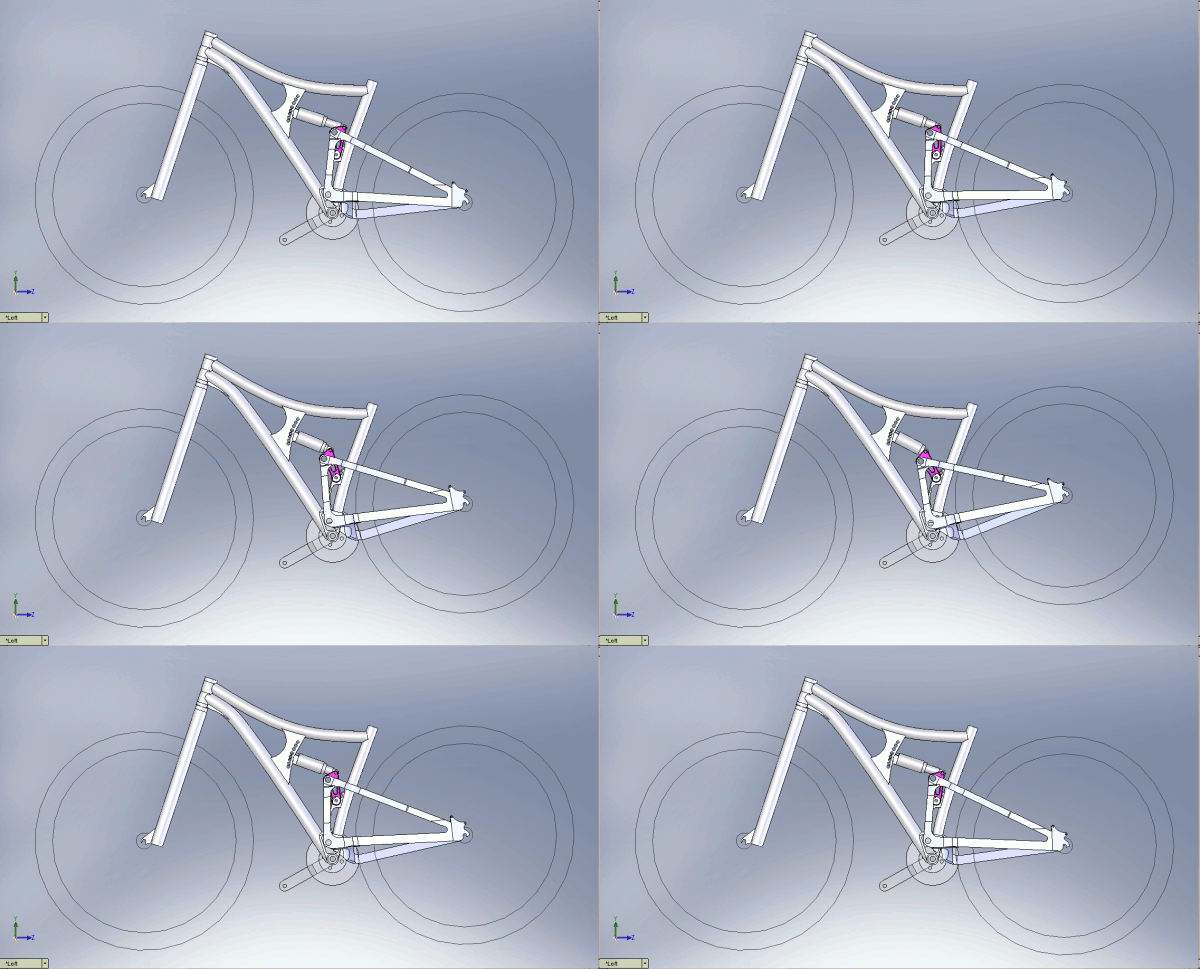
Those of you who really geek out on suspension systems will pretty quickly notice what’s so different about the design. What Sotto has developed for Yeti is the only other thing I’ve seen that orients the rockers in this position, and the designs seem very similar, though they’re doing something different from me. More on the actual swingarm motion later, or if anyone wants to contact me privately.
Anyway, I don’t have a welder or a machine shop, and I need to build a proof of concept to go test this thing. I’ve already been in touch with multiple builders to get an idea of time frame and cost of the project. Given all my recent rants about U.S. innovation and such, I naturally was trying to have the prototype built here in the States, so, as a kind of practical experiment, I contacted two different parties about building the proof of concept frame today: both are companies–not individuals–and one was in the U.S., while the other was in Taiwan. Both have already gotten back to me.
Decisions.
I’ve never been in the position of a manufacturer, paying for fabrication of a product. In both cases, I’m in the “about to sign a non-disclosure agreement” phase, but it will be really interesting to see how the two scenarios play out, and what the actual, landed, price difference will be. More than anything, it will just be tremendous learning experience to go through this process, and my goal is to document as much of it here as possible.
Though I’m not looking to launch a bike company right now, I think I might also need a name for a new company I need to create as the owner of this design. I named the last thing I did “Speedgoat,” so tough to say where I’d go with this.

